News & Updates
NSF invests nearly $8 million in inaugural cohort of open-source projects
NSF has announced the first Pathways to Enable Open-Source Ecosystems, or POSE, program awards to more than 20 Phase I projects. Researchers will create ecosystems for materials science research, renewable energy adoption, natural hazards, health data sciences and informatics, supply chain monitoring, and many other important applications.
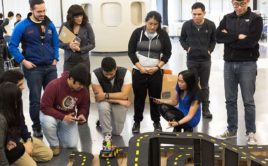
NSF invests to improve undergraduate STEM education at Hispanic-Serving Institutions
As the nation celebrates Hispanic Heritage Month, NSF's Improving Undergraduate STEM Education: Hispanic-Serving Institutions Program has awarded 48 grants to Hispanic-serving institutions in Fiscal Year 2022, totaling approximately $27 million to support various projects.

NSF grows future US manufacturing technologies and jobs
Manufacturing underpins US economic prosperity, security and employment. The White House recently published the US National Strategy for Advanced Manufacturing, with the NSF playing a critical role.
DOE Announces Historic $7B Funding Opportunity to Jump-Start America’s Clean Hydrogen Economy
The DOE opened applications for the $7 billion program to create regional clean hydrogen hubs (H2Hubs) across the country, which will form a critical arm of America's future clean energy economy. As part of a larger $8 billion hydrogen hub program funded through President Biden’s Bipartisan Infrastructure Law, the H2Hubs will be a central driver in helping communities across the country benefit from clean energy investments, good-paying jobs, and improved energy security.

NSF 101: Geographic diversity through EPSCoR
Ensuring that every citizen has access to STEM experiences is a critical piece to building an equitable research enterprise. Since 1979, NSF has addressed the need for geographic diversity through EPSCoR.
DOE Announces First Cohort of Post-Secondary Programs to Receive New Zero Energy Design Designation
The DOE Office of Energy Efficiency and Renewable Energy (EERE) awarded its first-ever Zero Energy Design Designation (ZEDD) seal of recognition to 17 leading educational programs that are preparing tomorrow’s architectural and engineering leaders to design and build the most sustainable buildings possible. This new DOE designation distinguishes post-secondary academic programs that impart the best practices of zero-energy design on students and require them to apply those building science concepts in actual projects.
NSF invests in bio-inspired and bioengineered systems for artificial intelligence, infrastructure and health
NSF announces an investment of $30 million to support new interdisciplinary, fundamental research projects for the Emerging Frontiers in Research and Innovation, or EFRI, program. Awardees will work on projects that involve engineering brain-inspired systems and creating safe and sustainable engineered living systems. Each $2 million, four-year award integrates research with ethical, legal, and social considerations and with broadening participation activities.
NSF's Convergence Accelerator invests $30M to tackle challenges related to the blue economy
NSF is tackling challenges related to climate, sustainability, food, energy, pollution and the economy through a $30 million investment to advance six convergent research teams from Phase 1 to Phase 2 of NSF's Convergence Accelerator Track E: Networked Blue Economy.

NSF announces increased support for capacity building in quantum information science and engineering research
The NSF Expanding Capacity in Quantum Information Science and Engineering program supports work in quantum fundamentals; metrology and control; co-design and systems; and education and workforce development. NSF invested $21,397,566 in 2022 ExpandQISE awards. Recipients from EPSCoR jurisdictions include:

Predicting and preventing pandemics is goal of new NSF awards
The potential for future pandemics is an ever-present and growing threat, whether they are due to known diseases like monkeypox or Ebola, or an as-yet-unknown infection. Nearly $26 million in new awards from NSF will support interdisciplinary investigations and collaborations that aim to predict and prevent the next infectious disease outbreak, significantly contributing to national security, public health and economic stability. NSF’s investments will support nearly 500 researchers located at nearly 50 institutions in 22 states and DC, including the following EPSCoR jurisdictions: