News & Updates
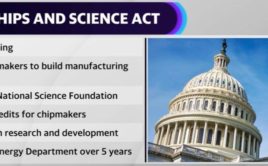
CHIPS and Science Act passed by Congress
On Thursday, July 28, the House passed the Creating Helpful Incentives to Produce Semiconductors (CHIPS) for America and Science Act by a vote of 243-187 following the Senate’s vote of 64-33 to pass the landmark legislation in that body on Wednesday. The measure will now be sent to the President for his signature.

NSF Taking Action: COVID-19 Diversity, Equity, & Inclusion (DEI) Challenge
NSF has announced the winners of the Taking Action: COVID-19 Diversity, Equity, & Inclusion (DEI) Challenge. The goals of this competition were to identify actions that Institutions of Higher Education (IHE) could take to ensure DEI in STEM despite the long-term challenges of the COVID-19 pandemic and to share these strategies broadly, including via social media and other means, thereby highlighting the importance of these actions, and providing information for others to implement these actions if applicable to their institutional context. NSF distributed a total of $200,000 in cash prizes.
New NSF center will advance, broaden and catalyze environmental data science
Understanding the impacts of climate change and the loss of biodiversity, and predicting and preparing for extreme environmental disturbances such as wildfires, floods and drought, require combining and synthesizing data sets that provide information at varying scales.
DOE’s Office of Science Expands Program for Faculty Historically Underrepresented in STEM Research
Applications are currently being accepted for the Spring 2023 term of the DOE Office of Science’s Visiting Faculty Program (VFP). The application deadline is Oct 5, at 5 pm EDT.

New Registering: Inaugural NSF EPSCoR EOD Conference, Sept 11-14, Isle of Palms, SC. Register by Sept 2.
South Carolina EPSCoR is very excited about the upcoming 2022 NSF EPSCoR Education, Outreach, and Diversity (EOD) Conference to be held Sept 11-14 at the Wild Dunes Resort in Isle of Palms, SC.

HHS awards over $155M to 72 teaching health centers
The US Department of Health and Human Services (HHS), through the Health Resources and Services Administration (HRSA), announced over $155 million in awards for 72 teaching health centers that operate primary care medical and dental residency programs. These awards are part of the Biden-Harris Administration’s work to expand and improve the distribution of the nation’s primary care workforce in economically disadvantaged areas.
NASA selects 5 proposals to provide new insights from openly available data in the Physical Sciences Informatics Systems
NASA’s Physical Sciences Research Program has selected five ground-based proposals in response to the Physical Sciences Informatics System call for proposals. This program element is part of Science Mission Directorate (SMD) Research Opportunities in Space and Earth Sciences - 2021 (ROSES-2021) solicitation. These five research projects, involving recognized experts in the fields of combustion science, complex fluids, fluid physics, informatics, and materials science, will use data contained in the PSI system and build on prior reduced-gravity research to advance fundamental research in the physical sciences.

NIH announces the newest MOSAIC Program Scholars
The Maximizing Opportunities for Scientific and Academic Independent Careers (MOSAIC) program is part of NIH’s efforts to enhance diversity within the academic biomedical research workforce, and is designed to facilitate the transition of promising postdoctoral researchers from diverse backgrounds, for example individuals from groups underrepresented in the biomedical research workforce at the faculty level, into independent, tenure-track or equivalent research-intensive faculty positions. The program has two components: an institutionally-focused research education cooperative agreement (UE5) and an individual postdoctoral career transition award (K99/R00) to enhance diversity. The objective of the MOSAIC Postdoctoral Career Transition Award to Promote Diversity (K99/R00) is to enhance workforce diversity by facilitating a timely transition of promising postdoctoral researchers from diverse backgrounds from their mentored, postdoctoral research positions to independent, tenure-track or equivalent research-intensive faculty positions.
NSF Research Traineeship program expands to include 43 states
NSF has announced 22 new awards through its NSF Research Traineeship (NRT) program. The $58 million investment, including $6.9 million of support from the American Rescue Plan Act of 2021, expands the program to comprise 43 states, the District of Columbia and the US Virgin Islands. This NSF program supports graduate students, educates the STEM leaders of tomorrow and strengthens the national research infrastructure. The awardees will focus on research and development in artificial intelligence and quantum information science and engineering – both national priorities of utmost importance.
Now Registering: 27th NSF EPSCoR National Conference, Nov 13-16, Portland, ME
Hosted by the University of Maine’s EPSCoR Office, the 27th NSF EPSCoR National Conference welcomes faculty, researchers, students and staff from EPSCoR jurisdictions around the country. Come Nov 13-16 for engaging speakers, breakout sessions and student poster presentations in Portland, Maine.