News Archives: June, 2022
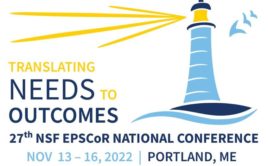
Now Registering: 27th NSF EPSCoR National Conference, Nov 13-16, Portland, ME
Hosted by the University of Maine’s EPSCoR Office, the 27th NSF EPSCoR National Conference welcomes faculty, researchers, students and staff from EPSCoR jurisdictions around the country. Come Nov 13-16 for engaging speakers, breakout sessions and student poster presentations in Portland, Maine.
NSF Convergence Accelerator EXPO 2022
The NSF Directorate for Technology, Innovation and Partnerships, or TIP, is pleased to share an exciting event opportunity. NSF’s Convergence Accelerator, a TIP program, is hosting its annual portfolio showcase event – Convergence Accelerator Expo 2022, virtual, July 27-28.
DOE Announces Winners of 2022 Marine Energy Collegiate Competition
First Hydropower Collegiate Competition and 2023 Marine Energy Collegiate Competition Competitors Also Announced
The DOE has announced the winners of the 2022 Marine Energy Collegiate Competition (MECC). Alongside the 2022 MECC winners, DOE also announced the new wave of students who will compete in the inaugural Hydropower Collegiate Competition (HCC) and 2023 MECC.
DOE Awards $110M for Groundbreaking Research by 83 Early Career Scientists
The DOE has announced the selection of 83 early career scientists from across the country to receive $110 million in funding for research covering a wide range of topics, from holography to particle accelerators. This year’s awardees represent 47 universities and 13 National Labs in 29 states. These awards are a part of the DOE’s long-standing efforts to develop the next generation of STEM leaders who will solidify America’s role as the driver of science and innovation around the world. Recipients from DOE EPSCoR jurisdictions include:
2022 NSF Policy Office Webinar Series: Subawards: Assessment, Approval, and Monitoring
NSF is pleased to announce the next webinar in the 2022 NSF Policy Office Webinar Series, covering Subawards: Assessment, Approval, and Monitoring, will take place on June 30, 2 to 3 pm EST. There is no cost to participate.
DOE to Support Clean Energy Transition in 12 Remote and Island Communities
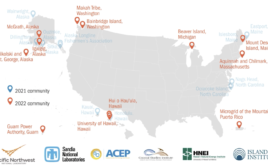
The DOE has announced it will work with 12 competitively selected remote and island communities around the United States to help strengthen their energy infrastructure, reduce the risk of outages, and improve their future energy and economic outlook. Through the Energy Transitions Initiative Partnership Project (ETIPP), DOE and its national and regional partners will support projects in communities that, due to their geographic isolation, often face high energy costs and vulnerable energy infrastructure due to their increased risk of natural disasters and climate change. ETIPP will leverage the world-class expertise of DOE's experts and National Labs to advance local clean energy solutions and improve resilience for the 12 selected communities which, like other remote and island areas, often lack the financial resources and the access to experts to plan a clean energy transition. Selected communities in EPSCoR jurisdictions are: