Research Highlights
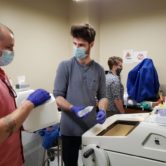
MAINE: INBRE professor and team of student research assistants discover new gene that may have impact on understanding common diseases
Dr. Timothy Brenton, University of Maine Framington professor of biology, and team of student research assistants have discovered a new gene in fish that may have an impact on understanding several diseases found in humans, including diabetes, schizophrenia and autism spectrum disorder.
The three-year research project recently published in the international journal Scientific Reports is funded by several grants totaling over $75K from the NIH through Maine INBRE and the MDI Biological Laboratory.

ALASKA: INBRE collaborates with COVID Variants Dashboard
Alaska INBRE is pleased to share the Alaska Coronavirus Variants Dashboard generated as a collaboration with the Alaska SARS-CoV2 Sequencing Consortium. The public can easily explore variants by economic region of Alaska, in vaccine breakthroughs, and over time.
Coronavirus variants have the potential to spread more rapidly, cause more severe disease, evade diagnostic detection, or reduce vaccine efficacy. With emergency use authorization (EUA) of monoclonal antibody treatments, which are targeted towards particular variants, this data can help guide what treatment to give patients by helping determine what variant patients are most likely infected with. Timely and accurate surveillance of SARS-CoV-2 variants is key to informing public health policy and thus efforts to control the pandemic in Alaska.

ALASKA: NSF EPSCoR Summer of Science
Earlier this summer, 18 high-school aged Alaskan girls piled into kayaks and packrafts and emerged with both new ecological knowledge and a lot more confidence in themselves.
That’s the idea behind “Girls on Water” and “Girls in the Forest,” two Alaska NSF EPSCoR-sponsored experiential learning programs that overcame COVID hurdles to hold successful wilderness expeditions in 2021. In July, nine 16- and 17-year-old girl-identified youths from across the state took part in “Girls on Water,” a week-plus scientific kayak expedition in Kachemak Bay. Then in August, nine “Girls in the Forest” spent more than a week packrafting the Chena River and learning about fire science along the way.
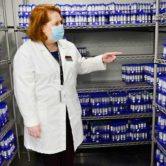
SOUTH CAROLINA: Thousands of tubes of spit are saving lives on college campuses across SC. Here's how.
A gentle hum can be heard from a lab in the depths of the University of South Carolina's life sciences building. Take a peek inside, and you'll find something unusual. Thousands of tubes of the spit belonging to the university's students, faculty, staff and Columbia residents.
Almost a year ago, the school's colon cancer lab changed course from its usual area of study and started analyzing how it could help as COVID-19 ravaged the world, killing hundreds of thousands across the country and shutting down campuses.
USC professors had a breakthrough when they started studying saliva there, said biomedical sciences professor Phillip Buckhaults.
The lab is testing about 2,000 samples a day and returning samples within 24 hours, and its reach is beyond the Midlands. Quick-turnaround testing allows people to identify themselves as COVID-19-positive earlier and isolate themselves, reducing the spread of the virus and saving lives.
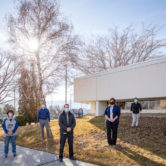
NEVADA: Nevada State Public Health Lab plays vital ‘front line’ role throughout pandemic
During a time where quality COVID-19 testing and reputable scientific information is in high demand, the Nevada State Public Health Laboratory (NSPHL), part of the University of Nevada, Reno School of Medicine, continues to step up. The lab was the first public health lab in Nevada to run COVID-19 diagnostics tests, and has become a major testing center throughout the pandemic. The NSPHL participates in several research projects and offers guidance to regional and state officials. All the while, the lab’s efforts often involve collaboration with University faculty and students, regional partners and federal organizations.
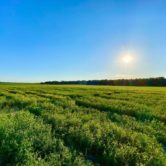
SOUTH CAROLINA: Clemson research aims to help SC farmers meet demand for more nutritious legumes
Organic farming sometimes has a bad reputation for producing legumes with lower nutritional quality. But some Clemson University researchers believe field peas and lentils can be grown organically and still have improved nutrient quality.
Thavarajah, the lead investigator for the project and a Clemson associate professor of pulse quality and organic nutritional breeding, said this research is needed because consumer demand for organically grown plant-based protein is increasing.
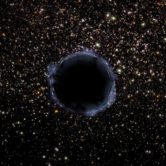
NEW HAMPSHIRE: Scientists introduce theoretical method to produce light in a vacuum
A new theory suggests that light can escape vacuums. Researchers from Dartmouth College funded by the NSF have developed a theoretical method to produce light from an electromagnetic vacuum, something once thought unobservable. The research sheds light on the nature of black holes and their massive gravitational pull.
The team published its findings in Communications Physics. The scientists propose that using photon detectors in an electromagnetic vacuum and enhancing the output to increase visibility demonstrates that photons can escape a vacuum.
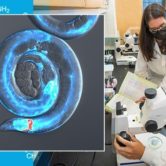
DELAWARE: A UD study with worms provides intriguing results
Worms don’t wiggle when they have Alzheimer’s disease. Yet something helped worms with the disease hold onto their wiggle in Dr. Jessica Tanis’s lab at the University of Delaware.
In solving the mystery, Tanis and her team have yielded new clues into the potential impact of diet on Alzheimer’s, the dreaded degenerative brain disease afflicting more than 6 million Americans.
“As humans, we have immense genetic diversity and such complex diets that it makes it really hard to decipher how one dietary factor is affecting the onset and progression of Alzheimer’s,” Tanis said. “That’s where the worms are amazing. The worms we use all have exactly the same genetic background, they react to amyloid beta like humans do, and we can exactly control what they eat, so we can really get down to the molecular mechanisms at work.”
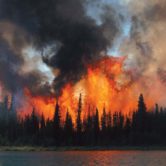
ALASKA: NSF EPSCoR researchers featured in Scientific American
Alaska EPSCoR Boreal Fires researchers Randi Jandt and Alison York were recently published in Scientific American in an article entitled, “Wildfire is Transforming Alaska and Amplifying Climate Change.”
Wildfires across the high north are increasing in frequency and size. They are also transforming landscapes and ecosystems. In addition to being a fuel, duff is a remarkable insulator of underlying frozen ground—so much so that it has been keeping much of subsurface Alaska frozen since the Pleistocene epoch. Each half-inch of thickness keeps the underlying permafrost—ground that remains below freezing for two or more years—about 1 degree Fahrenheit (0.6 degree Celsius) cooler. But if enough duff burns off, the underlying permafrost thaws, turning parts of Alaska into softening, slumping ground. Trees rooted in this thawing ground can tilt at all angles, like haphazard Leaning Towers of Pisa.
Extensive wildfire is accelerating climate change, too. Large fires throw a stunning amount of carbon dioxide into the atmosphere. Most of it comes from the duff, not the trees. The thick duff layers across high latitudes store 30 to 40 percent of all the soil carbon on Earth. In 2015 severe wildfires in interior Alaska burned 5.1 million acres, releasing about nine million metric tons of carbon from standing vegetation—and 154 million tons from the duff, according to Christopher Potter of NASA's Earth Sciences Division. (That calculation includes carbon lost to decomposition and erosion for two subsequent years.) The total amount of CO2 is equal to that emitted by all of California's cars and trucks in 2017. As more ground thaws, ice in the lower layers of duff melts and drains away, drying the duff farther down, making it more ready to burn deeply. This feedback loop most likely will expand the acres burned, aggravate health for millions of people and make the climate change faster than ever. Feedbacks may even convert the entire region from one that absorbs more carbon than it emits to one that emits more carbon than it absorbs.
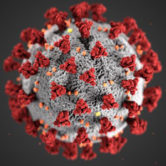
NEBRASKA: New strategy to prevent viral infections, including coronavirus
Researchers at the University of Nebraska Medical Center have developed a modular vaccine system that can be used to generate vaccines against known and emerging viral pathogens. The system can rapidly generate vaccine candidates and allows for the incorporation of multiple peptide-based antigens from a virus of interest or from multiple viruses. Since multiple antigens can be combined in one vaccine, it can help increase the efficacy of vaccines against emerging viral diseases. More