ALASKA: NSF EPSCoR researchers featured in Scientific American
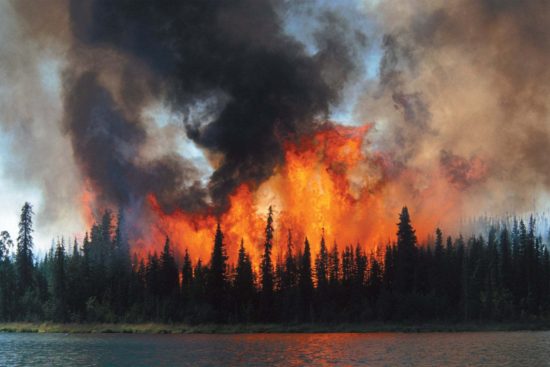
Alaska EPSCoR Boreal Fires researchers Randi Jandt and Alison York were recently published in Scientific American in an article entitled, “Wildfire is Transforming Alaska and Amplifying Climate Change.”
Wildfires across the high north are increasing in frequency and size. They are also transforming landscapes and ecosystems. In addition to being a fuel, duff is a remarkable insulator of underlying frozen ground—so much so that it has been keeping much of subsurface Alaska frozen since the Pleistocene epoch. Each half-inch of thickness keeps the underlying permafrost—ground that remains below freezing for two or more years—about 1 degree Fahrenheit (0.6 degree Celsius) cooler. But if enough duff burns off, the underlying permafrost thaws, turning parts of Alaska into softening, slumping ground. Trees rooted in this thawing ground can tilt at all angles, like haphazard Leaning Towers of Pisa.
Extensive wildfire is accelerating climate change, too. Large fires throw a stunning amount of carbon dioxide into the atmosphere. Most of it comes from the duff, not the trees. The thick duff layers across high latitudes store 30 to 40 percent of all the soil carbon on Earth. In 2015 severe wildfires in interior Alaska burned 5.1 million acres, releasing about nine million metric tons of carbon from standing vegetation—and 154 million tons from the duff, according to Christopher Potter of NASA's Earth Sciences Division. (That calculation includes carbon lost to decomposition and erosion for two subsequent years.) The total amount of CO2 is equal to that emitted by all of California's cars and trucks in 2017. As more ground thaws, ice in the lower layers of duff melts and drains away, drying the duff farther down, making it more ready to burn deeply. This feedback loop most likely will expand the acres burned, aggravate health for millions of people and make the climate change faster than ever. Feedbacks may even convert the entire region from one that absorbs more carbon than it emits to one that emits more carbon than it absorbs.
Authors
Randi Jandt is a fire ecologist, wildlife biologist and occasional firefighter at the International Arctic Research Center and the Alaska Fire Science Consortium at the University of Alaska Fairbanks.
Alison York is a researcher at the International Arctic Research Center and is coordinator for the Alaska Fire Science Consortium.