Research Highlights

LOUISIANA: LSU Pennington professor investigating how the brain and body fat communicate
Heike Muenzberg-Gruening, professor at Louisiana State Pennington Biomedical Research Center, is leading a new study to investigate how the brain and body fat communicate to control the production and release of leptin, a feedback hormone that helps regulate appetite and the number of calories burned.
The new project is one of seven awards involving interoception, a new research focus for the NIH. Interoception is not well understood, but if the process is not working properly, a person may not sense whether they are hungry, full, cold, hot or thirsty.
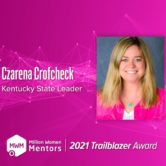
KENTUCKY: Two researchers receive national recognition
KY NSF EPSCoR Co-PI Dr. Czarena Crofcheck and EPSCoR researcher Rosemary Fama, both of University of Kentucky, were recognized with awards from Million Women Mentors.
Crofcheck received a States of the States Award for her exceptional commitment to advancing opportunities for girls and women in STEM across Kentucky.
Fama’s award was for her dedicated work with in supporting KY NF EPSCoR’s outreach, education, and broader impact programs.
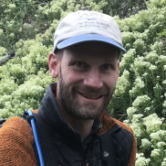
IDAHO: EPSCoR researcher spotlighted on national website
Dr. Paul Hohenlohe with Idaho EPSCoR was featured in Frontline Genomic’s “Down the Rabbit Hole: Conservation Genetics and the Tasmanian Devil.” Hohenlohe’s research focus is on the genomic architecture of evolving populations. He uses the power of modern genomics tools to address basic questions on evolution, conservation and cancer.
DELAWARE: PI publishes Council on Undergrad Research article
An article written by Delaware Tech, DE-INBRE Site PI, John McDowell and his colleagues examines the long-term education and career outcomes for alumni who participated in a URE (Undergrad Research Experience)-infused program over a five-year period in the Bioscience / Biotechnology Program at Delaware Technical Community College (DTCC). "Overwhelmingly, alumni realized they were confident and well-prepared for the next career challenge." The article appears in Scholarship and Practice of Undergraduate Research published by the Council on Undergraduate Research.
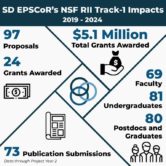
SOUTH DAKOTA: Project Year in Review: EPSCoR Research Within South Dakota
SD EPSCoR is celebrating year-two results from its NSF RII Track-1 project, 2D Best. The project year has brought many successes within science and technology research in the state. Participating in SD EPSCoR research are 69 faculty, 81 undergraduate students and 80 postdocs and graduate students. Project participants submitted 97 proposals and received 24 awards, totaling $5.1M. Research results have been described in 73 articles submitted for publication.
MAINE: INBRE researcher publishes research in BMC Microbiology
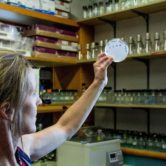
Results from research conducted in the lab of Maine INBRE project leader Dr. Sally Molloy provide evidence that prophage (integrated viral genomes) alter expression of important mycobacterial antibiotic resistance genes, as reported in the journal BMC Microbiology.
Co-authors include a graduate student at UMaine’s GSBSE and four undergraduates, including UMaine Honors College alumna Emma Freeman, who is now an MD student at Tufts Medical School.
Research reported in this project was supported by a University of Maine Faculty Development Grant and by an Institutional Development Award (IDeA) from the National Institute of General Medical Sciences of the National Institutes of Health under grant number P20GM103423.
CONNECTICUT: Unpeeled: A Food Marketing Label Game
Navigating the grocery store aisle is challenging for many consumers. Food manufacturers and distributors cover their boxed, canned, and bottled foods with labels like “whole grain” and “low-calorie” to suggest that their food has certain health benefits. The UConn Extension New Technologies in Agricultural Extension (NTAE) team, funded by USDA NIFA (EPSCoR), developed an interactive learning activity (or game), Unpeeled: The Case Studies of Maya McCluen. The purpose of this game is to increase our audiences’ understanding of food marketing labels.

ALASKA: Study finds increasing potential for toxic algal blooms in a warming Alaskan Arctic
Changes in the northern Alaskan Arctic Ocean have reached a point at which a previously rare phenomenon – widespread blooms of toxic algae – could become more commonplace, potentially threatening a wide range of marine wildlife and the people who rely on local marine resources for food. The NSF study by scientists at the Woods Hole Oceanographic Institution and other institutions looked at samples from seafloor sediments and surface waters collected during 2018 and 2019 in the region extending from the northern Bering Sea to the Chukchi and Beaufort Seas north of Alaska.

SOUTH CAROLINA: EPSCoR faculty receive NSF CAREER Awards
Two SC EPSCoR researchers have received NSF CAREER Awards. Clemson University faculty Drs. Angela Alexander-Bryant and Jessica Larsen were both South Carolina NSF RII Track-1 award, Materials Assembly and Design Excellence in South Carolina (MADE in SC), hires during the first year of the project.
OKLAHOMA: NSF EPSCoR Social Dynamics Team Conducts Policy Landscape Mapping
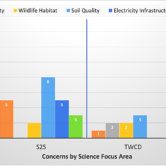
S3OK OK NSF EPSCoR Social Dynamics Team Conducts Policy Landscape Mapping. Dr. Kristin Olofsson, Assistant Professor of Political Science at Oklahoma State University, and a team of researchers and students collaborated to map policy landscapes of each of the four Focus Areas of the S3OK project. In policy landscape mapping, the team identifies who is involved in the issue, who is affected by the issue, related goals within the focus area, and the narratives told by those individuals about the issue.