Research Highlights
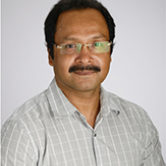
KANSAS: INBRE Researcher named recipient of University of Kansas Scholarly Achievement Award
Soumen Paul, University of Kansas Medical Center, is one of four KU scholars to receive the University Scholarly Achievement Award. He is a past Kansas INBRE Pilot and Bridging Grant awardee.
The University Scholarly Achievement Award recognizes truly outstanding scholarly or research contributions, with one award given each year in each of four categories: arts and humanities; medicine and clinical sciences; science, technology and mathematics; and social science and professional programs.
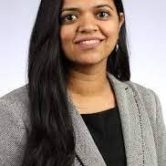
ARKANSAS: Estimating Bone Health Among Hemophilia Carriers and von Willebrand Disease Patients
In the US, approximately 1.5 million individuals experience bone fractures related to osteoporosis each year. In addition to this being a major public health concern, it poses a significant financial burden.
Recently, issues with bone health have gained attention around how they relate to bleeding disorders. Individuals with hemophilia tend to have low bone mineral density that’s believed to be a consequence of prolonged immobility, recurrent hemarthrosis, decreased weight bearing, lower physical activity level and obesity.
While there’s some literature relating to bone health and hemophilia, there’s a lack of understanding around impaired bone health in individuals with von Willebrand disease (vWD) and those who are hemophilia carriers (HC). This motivated investigators to estimate the prevalence of osteoporosis, osteoarthritis and bone fractures in these individuals.
Research led by Divyaswathi Citla-Sridha at the University of Arkansas for Medical Sciences found people with von Willebrand disease or hemophilia have significantly higher risks for osteoporosis, osteoarthritis and bone fractures than the general population. Ten risk factors, including vitamin D deficiency, obesity, hypothyroidism, smoking and use of corticosteroids or nonsteroidal anti-inflammatory drugs, were more prevalent in cases, compared with controls.
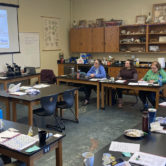
ALASKA: EPSCoR teaches teachers
Alaska EPSCoR and Sitka Science recently held a workshop to teach nine Sitka-area educators how to deliver an EPSCoR wildfire ecology curriculum that uses a board game to teach students about topics like the fire triangle and fire behavior.
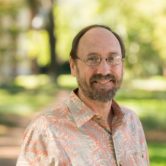
SOUTH CAROLINA: SC INBRE student mentor wins Goldwater Mentor Award
SC INBRE Student-Initiated Research Project Program (SIRP) student mentor George Shields, Furman University, has been recognized for his mentorship as the recipient of the 2022 Faculty Mentor Award from the Council on Undergraduate Research and the Barry Goldwater Scholarship and Excellence in Education Foundation. Four students under the chemistry professor’s tutelage have won Fulbright awards and 13 became Goldwater Scholars, including five at Furman, three of those in 2021.
MISSISSIPPI: INBRE funds K-12 STEM education
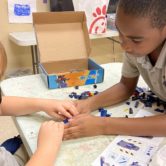
Mississippi INBRE recently awarded a grant totaling nearly $2,500 to Mt. Salus Christian School, a private K-12 school based in Clinton, MS. Mt. Salus used the grant to purchase materials for multiple STEM-focused classes, ranging from simple wrenches and screwdrivers to microscopes and even robots. Mt. Salus reports that these materials have made a profound difference in the quality of education the students have received. Many have even expressed an interest in pursuing a STEM-focused career during college and beyond.
KANSAS: Mobile Microbe Exhibit Visits Independence
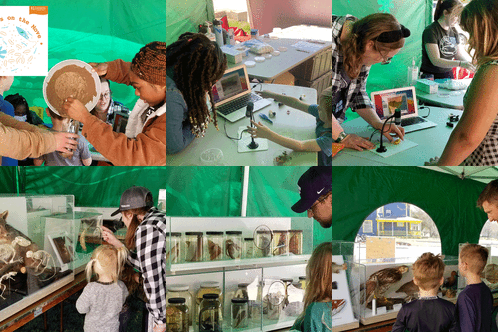
Recently Independence, KS residents found more than books to check out at their local library. They found “Microbes on the Move,” a traveling program from KU Natural History Museum, funded by Kansas NSF EPSCoR. The interactive event drew many visitors, giving Kansans of all ages a chance to learn about how microbes – tiny life that take a microscope to see – live among us and connect with other lifeforms.
NEW HAMPSHIRE: NSF EPSCoR researchers published in Cell Reports Physical Science
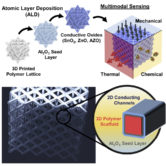
Research seed grants from the New Hampshire EPSCoR Track-1 project continue to sprout interesting biosensing technology results. Dartmouth graduate student Julia E. Huddy and her advisor, Assistant Professor of Engineering William Scheideler just had their paper published, “Transforming 3D-printed mesostructures into multimodal sensors with nanoscale conductive metal oxides” in Cell Reports Physical Science, available now through open access.
DELAWARE: Former Delaware INBRE student featured in an article in CRISPR Medicine News
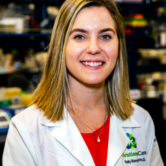
Kelly Banas, along with colleagues at ChristianaCare and University of Delaware, Newark, have developed an innovative CRISPR strategy to restore the chemosensitivity of non-small cell lung cancer cells.
Resistance to chemotherapy is a major challenge in the treatment of non-small cell lung cancer. By profiling the spectrum of outcomes arising from CRISPR-based knockout of the NRF2 protein, which contributes to chemoresistance, Eric Kmiec Ph.D. and Kelly Banas Ph.D. of the ChristianaCare Gene Editing Institute have developed a new therapeutic strategy that increases the sensitivity of cancer cells to traditional chemotherapy.
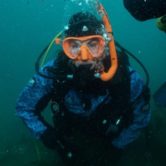
ALASKA: NSF EPSCoR divers receive certification
If you think getting out on the water in Alaska in March sounds chilly, consider the folks who just spent most of a week underneath it. Three University of Alaska-Fairbanks College of Fisheries and Ocean Sciences (CFOS) students received Alaska NSF EPSCoR Fire & Ice rolling travel awards to travel to Kasitsna Bay Lab over spring break to attend UAF’s Scientific Diving class, instructed by Fire & Ice PI Brenda Konar. Students emerged from the course with their American Academy of Underwater Sciences Scientific Diver certification, as well as other certifications.
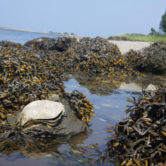
RHODE ISLAND: EPSCoR researchers study the symbiotic relationships between oysters and bacteria living in their gut microbiome
Living in shallow, brackish waterways like the state’s southern salt ponds, the Eastern or Atlantic oyster, Crassostrea virginica, provides habitats for other species and, as a filter feeder, serves as a natural indicator of a marine environment’s water quality.
After months in the lab, extracting and sequencing DNA of a bacteria living in the gut of the Eastern oyster, Rhode Island EPSCoR’s Zachary Pimentel faced a big problem: he couldn’t find any trace of the bacteria. Pimentel belongs to a group of researchers at the University of Rhode Island and Roger Williams University investigating how certain bacteria operate in the Eastern oyster’s gut microbiome, knowledge of which helps the scientific community better understand how such bacteria impact its host’s overall health.