Research Highlights
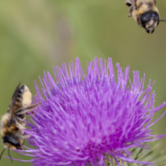
NEW HAMPSHIRE: Rare plants attract rare bees and birds in urban gardens
Little is known about what drives rare biodiversity in cities. Rare plant species in urban gardens may be the answer. The plants in turn attract rare bee and bird species, according to a Dartmouth College-led study looking at urban gardens in northern California.
The NSF-supported results, published in Ecological Applications, show that women, older gardeners, and those who live near the gardens tend to curate more rare plants. "There appears to be a cascading effect of people planting uncommon species on the accumulation of other uncommon bee and bird species," says lead author Theresa Ong.
NEBRASKA: EPSCoR researchers publish new study on nitrogen fertilization in crop production
Nebraska EPSCoR Center for Root and Rhizobiome Innovation researcher Jinliang Yang and others have recently published, “Estimating the genetic parameters of yield-related traits under different nitrogen conditions in maize,” in bioRxiv.
Nitrogen (N), as a fundamental macronutrient, is a major constituent of proteins, nucleic acid, and metabolites and is critical for the high yielding of crops. Since the 1960s, subsequent to the Green Revolution, due to the Haber-Bosch process, inorganic N fertilizers became increasingly available for crop production, especially in maize, where about 20% of the N fertilizers was applied for maize production. However, inefficient N usage causes ammonia emission to the environment, accounting for a considerable proportion of fine particulate matter pollution (i.e., PM2.5) and reducing human population life span. Meanwhile, N runoff imposes substantial adverse effects on natural ecosystems, such as reduced water quality and impaired soil health. Therefore, understanding the plant response to N in crop production is crucial for human health, food security, and environmental sustainability and is a long-standing research topic in plant breeding and genetics.
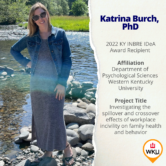
KENTUCKY: Meet KY INBRE funded researcher Katrina Burch
KY INBRE’s weekly newsletter series introduces the 2022 KY INBRE funding recipients. This week, meet Dr. Katrina Burch, Western Kentucky University, recipient of a KY INBRE IDeA award. “I’m investigating the short and long-term effects of experiencing workplace incivility, which has been on the rise in the last few years. Funding from KY INBRE has helped to tremendously, allowing the time and resources necessary to conduct this research which I am passionate about.”
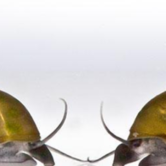
IOWA: New NSF- funded study looks at freshwater snail invasion
In a new study, biologists at the University of Iowa looked at why a type of freshwater snail that has invaded ecosystems worldwide has been so successful. Their conclusion: The lineages that were the most successful invaders matured and reproduced more quickly than noninvasive counterparts within the species.
The NSF-supported study was published in the journal Oecologia.
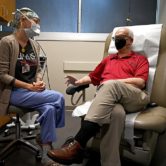
ARKANSAS: New device offered by UAMS relieves diabetic neuropathy pain
A device that aims to lessen the pain of nerve damage caused by diabetes is available to people with the disease thanks in part to a trial led by Erika Petersen, neurosurgeon and professor at the University of Arkansas for Medical Sciences. The Nevro HFX spinal cord stimulator was approved by the FDA in 2021 after Petersen's trial showed the device could reduce by 50% the pain of diabetic neuropathy, which afflicts around half of people with diabetes.
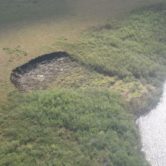
ALASKA: NSF EPSCoR hire co-authors climate change study
Alaska NSF EPSCoR Fire & Ice faculty hire Simon Zwieback co-authored a recent study of the contribution of thawing Arctic hillsides to climate change. The findings were published July 15, 2022, in The Cryosphere, a journal of the European Geosciences Union. They are the first based on the use of satellite imagery to estimate carbon release from slumping Arctic hillsides.
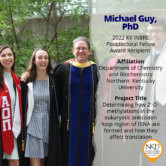
KENTUCKY: Meet KY INBRE funded researcher Michael Guy
KY INBRE has started a brand new weekly series in their newsletter introducing the 2022 KY INBRE funding recipients. This week, meet Dr. Michael Guy, Northern Kentucky University, recipient of a Postdoctoral Fellow award.
Said Guy, “Our lab studies transfer RNA (tRNA), which is a molecule required to read the information in your genes and convert it into the proteins that give cells their shape and perform chemical reactions. To function properly tRNAs must be modified by the cell, and we study the proteins that form these modifications. People with defects in these modifications often suffer from intellectual disability or other diseases.”
“KY INBRE funding has allowed us to hire a fantastic lab technician who keeps the lab running smoothly and helps me train students and direct their research.”
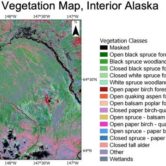
ALASKA: EPSCoR student lead author of paper in International Journal of Applied Earth Observation and Geoinformation
Alaska EPSCoR PhD student Anushree Badola is lead author on an article just published in the International Journal of Applied Earth Observation and Geoinformation, describing a method of simulating hyperspectral imagery from satellite images.
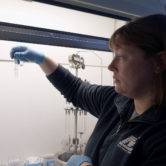
ALASKA: NSF EPSCoR researchers use biochemical lab techniques to collect marine life data
Fire & Ice researchers Julie Schram (pictured) and Jessica Glass are doing things the easy way. At least, that’s the idea. Schram, a Co-PI (and a faculty hire) of the Alaska NSF EPSCoR Fire & Ice project and an Assistant Professor of Animal Physiology at the University of Alaska Southeast, and Glass, a fellow Fire & Ice faculty hire and an Assistant Professor in the UAF College of Fisheries and Ocean Sciences, are using biochemical lab techniques that enable them to collect data about marine life and their interactions without having to directly observe them in real time.
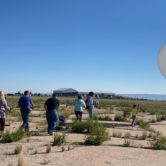
WYOMING: Space Grant holds High-Altitude
Last week, Wyoming Space Grant hosted a small group of educators for their first high-altitude balloon workshop in many years. The group received a crash course in the art of high-altitude ballooning. To cap it off, they successfully flew payloads they built up to 90,000 feet. The Summer 2022 High-Altitude Balloon Workshop was held July 26-28, at the University of Wyoming in Laramie.
Workshop was open to teachers and educators based in Wyoming. No prior ballooning experience was required.
Workshop attendees learned about:
- Educational opportunities available through the Wyoming NASA Space Grant
- The history and future of Wyoming Space Grant’s high-altitude balloon program
- The entire high-altitude balloon process from start to finish (i.e., payload development, logistics, launch, tracking, and recovery)
- Ways to implement balloon payload development, experiment design, and data analysis in the classroom