Research Highlights
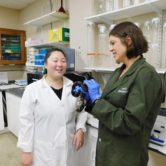
ARKANSAS: Grant funds snake immunity research
Snakes have a unique immune strategy that has caught the attention of Arkansas State University Assistant Professor of Physiology Lori Neuman-Lee, who was awarded a $40,000 grant from the Arkansas INBRE to study these creatures and their immunities. “There are two types of immune systems, adaptive and innate,” Neuman-Lee said, noting that reptilian cells are much heavier allowing snakes and other reptiles to use their innate immune system almost exclusively. This allows the snakes to fight off infections rapidly.
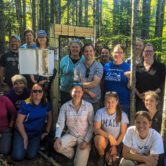
MAINE: EPSCoR Track-2 Project creates Community Collective
INSPIRES, an NSF EPSCoR RII Track-2 grant that focuses on gathering, analyzing, and utilizing data collected from across the Northern Forest Region, has partnered with the Maine Center for Research in STEM Education (RiSE Center), an interdisciplinary research center at the University of Maine. The RiSE Center provides support for twenty-two faculty members conducting educational research within their different STEM disciplines (e.g., chemistry, physics, mathematics, engineering) through various programs and projects. INSPIRES and RiSE have provided a rare opportunity — especially in a science-based research project—for middle and high school teachers from across Maine and Vermont to act as researchers.
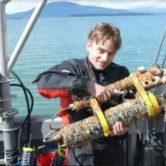
ALASKA: Alaska Native News highlights EPSCoR researchers
Recently, Alaska Native News highlighted Alaska EPSCoR Fire & Ice researchers Amanda Kelley and Jamie Currie and their efforts to monitor ocean acidification in Kachemak Bay. University of Alaska-Fairbanks College of Fisheries and Ocean Sciences professor Kelley and graduate student Currie are collecting data from Kachemak Bay to gain more insight into how pH conditions are changing in Alaska’s nearshore waters.
ALABAMA: Groundbreaking Medical AI Program to Hit Market in Near Future
Researchers at the University of Alabama in Huntsville created an artificial intelligence program that watches chemical reactions in cells on a mass scale to help biophysicists understand how the reactions happen, knowledge that will speed up the development and improve the quality of new drugs. Kannan Grant, director of UAH's commercialization office, said the office will help the researchers find a path to develop their patented technology within the next six months.
The technology utilizes complex analytics programs to rapidly observe vast quantities of complex interactions between chemicals within living cells. The application of sheer computational power to these interactions enable biophysicists to more quickly and efficiently discern the laws governing those interactions, resulting in faster, more precise, and even less expensive development of pharmaceuticals.
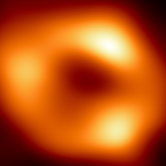
Black hole discovered with NSF support
At the center of our very own Milky Way galaxy, scientists long suspected that there was a supermassive black hole, and they named this black hole Sagittarius A* (Sgr A*, pronounced "sadge-ay-star"). Thanks in part to US National Science Foundation support, their years of rigorous research confirmed their suspicions. On May 12, 2022, scientists released the first direct visual evidence of Sgr A*.
Because it's located at the center of the Milky Way, understanding how Sgr A* functions is fundamental to the larger goal of understanding how our galaxy formed and continues to evolve.
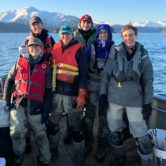
ALASKA: EPSCoR kicking off summer fieldwork
Alaska EPSCoR Fire and Ice is kicking off another summer of fieldwork. Here are (l to r) student Emily Reynolds, faculty Jessica Glass, student Karen Grosskreutz, student Lindsey Stadler, student Maddi McArthur, and faculty Brenda Konar in Kachemak Bay. Photo by Mike Geagel.
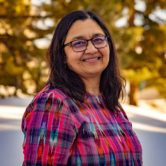
ALASKA: EPSCoR co-lead receives research award
Alaska EPSCoR Boreal Fires co-lead Uma Bhatt, professor of atmospheric sciences at the Geophysical Institute and College of Natural Science and Mathematics, has been named winner of this year’s University of Alaska-Fairbanks Emil Usibelli Distinguished Research Award.
Bhatt, who holds a master’s degree and a doctorate in atmospheric sciences, arrived at UAF in 1998. She also has two bachelor’s degrees: one in Russian and another in mechanical engineering.
At UAF, she has conducted wide-ranging research into climate-related phenomena of value to scientists, resource managers and industries. She published a groundbreaking study of the connection between sea ice and tundra vegetation, and she currently leads a worldwide effort to better predict the seasonal extent of sea ice. She also is working on methods to seasonally forecast wildland fire risks.
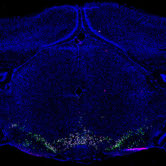
ALABAMA: UAB Researchers have mapped cells playing a key role in the brain
Researchers at the University of Alabama at Birmingham have mapped 16 groups of cells that play a key role in how dopamine and other neurotransmitters travel through the brain. By identifying the cell groups in the brain's ventral tegmental area, UAB researchers laid the building blocks for future research on how the groups interact and connect to the rest of the brain in people with addiction, attention-deficit/hyperactivity disorder and other neurological conditions.
This research was partially funded by grants from the NIH.
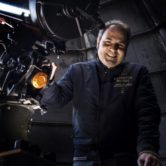
KENTUCKY: NASA KY Space Grant astronomer and team discover most distant megamaser yet found – 5 billion light years away
NASA KY Space Grant researcher Benne W. Holwerda, University of Louisville, and an international team of researchers have discovered a powerful megamaser — a radio-wavelength laser emission usually indicative of colliding galaxies — that is the most distant such megamaser found so far.
Working on a project called “Looking at the Distant Universe with the Meerkat Array” (LADUMA), the team is using the MeerKAT radio telescope in South Africa to look for neutral hydrogen gas in galaxies that are very, very far away, both in space and in time. By measuring the neutral hydrogen gas in galaxies from the distant past to now, LADUMA will contribute to our understanding of the evolution of the universe.
The discovery was made by LADUMA, led by Holwerda, Andrew Baker of Rutgers University and Sarah Blyth of the University of Cape Town in South Africa, in some of the first data the team obtained from the MeerKAT, which was commissioned in 2019.
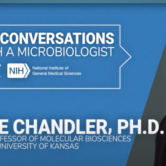
KANSAS: Researcher featured in NIH video series
Josephine (Josie) Chandler, PhD, first became interested in science when she took a high school chemistry class. In college, she fell in love with microbiology and ultimately earned a Ph.D. in the field. Today, she’s an associate professor of molecular biosciences at the University of Kansas in Lawrence, where her lab investigates interactions in bacterial communities. NIGMS recently featured Dr. Chandler in their video series, Career Conversations.