Research Highlights
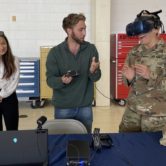
RHODE ISLAND: INBRE Core creates VR apps
Rhode Island INBRE’s Molecular Informatics Core collaborated with faculty around the state and completed virtual reality (VR) apps resulting from their Enhanced Virtual Education, Research, and Training (EVEREST) awards.
Two apps for training in methods to produce nanoparticles and liposomes for drug delivery were demonstrated at the 2022 Rhode Island National Guard STEM Exploration Open House for high school students, in addition to other technology.
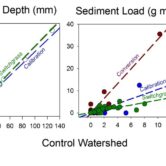
OKLAHOMA: EPSCoR researchers publish “Switchgrass Conversion of Marginal Grassland = Min. Impacts Land/Water Systems”
Oklahoma NSF EPSCoR S3OK researchers Drs. Chris Zou and Rodney Will, professors of Natural Resource Ecology and Management at Oklahoma State University (OSU) collaborated with Dr. Lixia Lambert and Mr. Joshua Everett also from OSU to study land and water system dynamics (i.e., runoff and sediment yield) that were related to the conversion of a marginal grassland watershed to a switchgrass biomass production system. The research team used two experimental watersheds that were previously established at OSU’s Range Research Station. One watershed served as the untreated Control Watershed and the second as the Impact Watershed that was converted into “Alamo” switchgrass production system.
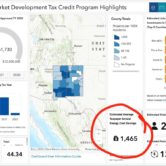
NEW MEXICO: New Mexico’s Energy Transition Story
How will New Mexico’s energy transition policies impact YOU? Learn now through a story map PhD candidate Jason Banegas made for Energy, Minerals and Natural Resources Department of New Mexico/New Mexico EPSCoR.
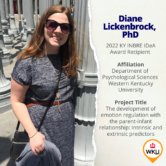
KENTUCKY: Meet KY INBRE funded researcher Diane Lickenbrock
KY INBRE’s weekly newsletter series introduces the 2022 KY INBRE funding recipients. This week, meet Dr. Diane Lickenbrock, Western Kentucky University, recipient of a KY INBRE IDeA award: “The funding from KY INBRE has helped us purchase equipment and supplies needed for the project. It has also funded graduate students, as well as summer student research assistants who help with the project. The data from this project has supported NIH grant applications for funding to continue examining contributors of infant emotion regulation development.”
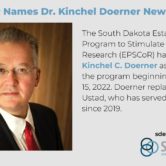
SOUTH DAKOTA: SD EPSCoR Names New Director
Ustad will remain the lead Principal Investigator (PI) on the current five-year NSF EPSCoR Research Infrastructure Improvement (RII) Track-1 award that involves six South Dakota public universities, two private universities, three tribal colleges, and state agencies. The project’s objective is to develop South Dakota’s research infrastructure, support STEM education and technology-based economic development.
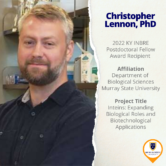
KENTUCKY: Meet KY INBRE funded researcher Christopher Lennon
KY INBRE’s weekly newsletter series introduces the 2022 KY INBRE funding recipients. This week, meet Dr. Christopher Lennon, Murray State University, recipient of a KY INBRE Postdoctoral Fellow award: “Through this award, we are investigating the emerging regulatory role of inteins, as well as exploiting these elements in novel ways to develop useful applications in protein engineering.”
KENTUCKY: Dr. Kazi Javed, Director of KSU’s Peer-Led Team Learning Program, retires
Dr. Kazi Javed took a small Kentucky NSF EPSCoR grant for nanotube research at the University of Kentucky and evolved it into a program at Kentucky State University supporting hundreds of undergraduate students.
In July 2022, Dr. Javed retired, concluding his work as a teacher, mentor, and leader. “I mean this from the bottom of my heart, it’s not about me. It’s about how we started, how we performed, and how we can sustain it. I’d like to think of myself simply as the catalyst.”
With Kazi’s retirement, Dr. Suzette Polson, his longtime faculty colleague, is picking up the torch. “Dr. Polson has been coordinating the PLTL organic and biochemistry workshops since the inception of the program. I trust she will continue to grow the program. If it continues to have the impact, it is still worth supporting. For the STEM pipeline, and as the only HBCU university in the Commonwealth, it is incredibly important to do the best we can for our STEM students to succeed. I’ll be rooting for their success in every way I can.”
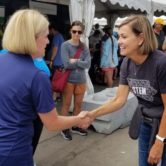
IOWA: Iowa Space Grant Consortium Fun at the Iowa State Fair
The Iowa Space Grant Consortium was recently at STEM Day at the Iowa State Fair. ISGC Interim Director, Sara Nelson (right), met with Iowa Governor, Kim Reynolds (left).
Prizes were given out. Attendees participated in a variety of STEM activities and filled out postcards to go out on a rocket to space.
SOUTH CAROLINA: INBRE researcher publishes new study on neuropeptide galatin
SC INBRE researcher Mike Giuliano, College of Charleston, and lab have recently published, “The neuropeptide galanin adopts an irregular secondary structure,” in Biochemical and Biophysical Research Communications. Said Giuliano, “Happy to share the the outstanding work of CofC Chem undergrad researchers Rachel Wilkinson, Katie Kraichely, and Cecilia Hendy! [Thank you to] SC INBRE for their support of my lab, and flexibility in funding during the pandemic – that let me pay our first author and rockstar Rachel Wilkinson.”
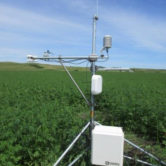
NORTH DAKOTA: Community college purchases equipment thanks to ND EPSCoR
Each year, the North Dakota EPSCoR State Office accepts competitive proposals for equipment that helps advance scientific inquiry and R&D. Turtle Mountain Community College (TMCC) received an award to procure a carbon flux measurement instrument. This instrument is designed to provide detailed measurements for carbon and water fluxes at a field scale, as well as detailed weather and soil information important to climatic effects on net ecosystem carbon gains and water losses. TMCC is working with the Tribal Agriculture and Natural Resources Departments to assist them with research pertaining to environmental quality and the effects of land management on carbon sequestration.