KENTUCKY: NASA KY Space Grant astronomer and team discover most distant megamaser yet found – 5 billion light years away
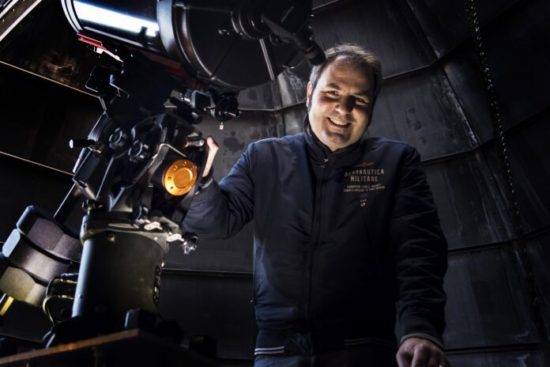
NASA KY Space Grant researcher Benne W. Holwerda, University of Louisville, and an international team of researchers have discovered a powerful megamaser — a radio-wavelength laser emission usually indicative of colliding galaxies — that is the most distant such megamaser found so far.
Working on a project called “Looking at the Distant Universe with the Meerkat Array” (LADUMA), the team is using the MeerKAT radio telescope in South Africa to look for neutral hydrogen gas in galaxies that are very, very far away, both in space and in time. By measuring the neutral hydrogen gas in galaxies from the distant past to now, LADUMA will contribute to our understanding of the evolution of the universe.
The discovery was made by LADUMA, led by Holwerda, Andrew Baker of Rutgers University and Sarah Blyth of the University of Cape Town in South Africa, in some of the first data the team obtained from the MeerKAT, which was commissioned in 2019.
“Twelve years ago, we proposed this research and were awarded the time on the MeerKAT radio telescope, which at the time was still under construction,” Holwerda said. “The discovery of this most distant hydroxyl megamaser came out of our hydroxyl maser science group and the data processing from our observing season at the MeerKAT. We expected to see one or two, but seeing one right off the start was a bit of a surprise. It was a neat moment. It is always fun when your data surprises you.”