News & Updates
NSF Campus Cyberinfrastructure EPSCoR Opportunity
NSF has issued a Dear Colleague Letter (DCL) entitled, “Towards an Equitable National Cyberinfrastructure.” Through this DCL, NSF's Office of Advanced Cyberinfrastructure and EPSCoR in the Office of Integrative Activities are specifically inviting proposal submissions to Campus Cyberinfrastructure (CC*) to address the disparities in campus-level networking and cyberinfrastructure that exacerbated the impacts of the COVID-19 pandemic in some areas of the country. There are several ways that such disparities could be addressed within the CC* programmatic framework. All projects supported by CC* must be driven by STEM research and education needs that require the support of networking and computing infrastructure on campuses. More

New NSF Division of Engineering Education and Centers Director
NSF has selected Dr. José Luis Zayas-Castro of the University of South Florida to serve as division director for the Division of Engineering Education and Centers. Zayas-Castro, who begins his NSF term on Aug 2, is currently executive associate dean, associate dean for international affairs, and professor of industrial and management systems engineering in the USF College of Engineering. He began his faculty career at the University of Puerto Rico-Mayagüez, where he led activities in manufacturing, innovation, and academic and research affairs. More
DOE to Provide $100 Million for High Energy Physics Research
The DOE announced a plan to provide $100 million over the next four years for university-based research on a range of high energy physics topics through a new funding opportunity announcement. The objective of this funding is to advance knowledge of how the universe works at its most fundamental level.
DOE Awards $45M to Advance Solar Manufacturing and Grid Technologies
The DOE has announced $45 million for projects that will help seamlessly integrate clean energy sources onto the grid. As solar and other renewable energy are rapidly deployed throughout the country, these projects are developing new technologies and capabilities to bolster the resilience of the US electric grid. The funding, which also creates a new $25 million consortium, will advance the domestic manufacturing of solar energy and electric grid technologies.

EIF Resources
Visit the EIF Resources tab to quickly find links to newsletter archives, news and updates, research highlights, student spotlights and success stories.
DOE Community College Internships (CCI) Program is now open for Spring 2022 applications
The CCI Program seeks to encourage community college students to enter technical careers relevant to the Department of Energy (DOE) mission by providing technical training experiences at the DOE laboratories. Selected students participate as interns appointed at one of 16 participating DOE laboratories. They work on technologies or instrumentation projects or major research facilities supporting DOE’s mission, under the guidance of laboratory staff scientists or engineers. Applications are due Oct 6. More

NSF selects Karen Marrongelle as COO
NSF has officially appointed Karen Marrongelle to serve as chief operating officer. Since 2018, she has led the NSF Directorate for Education and Human Resources, or EHR, which supports research that enhances learning and teaching, and broad efforts to achieve excellence in STEM education at all levels and in all settings.
DOE Announces New $60 Million Investment to Increase Energy Efficiency in Manufacturing
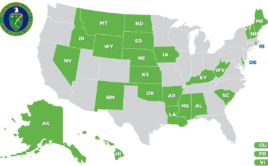
The DOE has announced $60 million in funding for its largest-ever cohort of university-based Industrial Assessment Centers (IACs), which assist small- and medium-sized manufacturers in reducing their carbon emissions and lowering energy costs, while training the next generation of energy-efficiency workers.
NSF Announces $30 Million Investment to Broaden Participation in Cutting-edge Materials Research
The NSF awarded its latest grants through PREM, Partnerships for Research and Education in Materials, to support eight collaborative research teams across the United States that will increase diversity in cutting-edge materials research, education and professions.
NASA Opens Call for 20th Annual Student Competition
Undergraduate and graduate students in STEM-related fields are invited to develop concepts for the 2022 Revolutionary Aerospace Systems Concepts – Academic Linkage (RASC-AL) competition that will help extend humanity’s presence further into the solar system.