News & Updates
NSF announced the launch of SpectrumX, an NSF Spectrum Innovation Center
NSF has announced a $25 million investment over five years to launch SpectrumX, an NSF Spectrum Innovation Center that will address the growing demand for usage of the radio spectrum. This represents the first federal investment in a national center focused on the transformation of wireless spectrum management. SpectrumX is a coalition of 29 institutions led by the University of Notre Dame.

EPSCoR jurisdictions receive NSF investment to build R&D capacity and education
NSF has invested nearly $40 million in nine projects that fund collaborative networks, spanning a total of 20 institutions in 15 jurisdictions, through NSF's EPSCoR Research RII Track-2. EPSCoR is designed to build research and development capacity in states that demonstrate a commitment to research but have not received the levels of investment seen in other parts of the country. These grants focus on building interjurisdictional collaborative teams of investigators in scientific focus areas consistent with NSF and national priorities.
NIH NIGMS MOSAIC Scholars Annnounced
The purpose of the NIH MOSAIC Postdoc Career Transition Award to Promote Diversity (K99/R00) program is to support a cohort of early career, independent investigators from diverse backgrounds conducting research in NIH mission areas. The MOSAIC K99/R00 program is designed to facilitate a timely transition of promising postdoctoral researchers from diverse backgrounds from their mentored, postdoctoral research positions to independent, tenure-track or equivalent faculty positions at research-intensive institutions.
DOE Announces “Waves to Water” Desalination Prize Final Stage Finalists
The DOE has announced five winners in the CREATE Stage of the Waves to Water Prize, a competition focused on using the power of waves to develop clean energy-powered desalination technologies to help provide potable water to communities in need. CREATE is the fourth of the five-stage Waves to Water Prize, with total funds of up to $3.3M.

New NSF science and technology centers to address vexing societal problems
NSF has announced six new Science & Technologies Centers to advance ambitious, complex research in fields ranging from mechanobiology to particle physics to climate change. The centers will focus on establishing new scientific disciplines and developing transformative technologies that have the potential for broad impacts on science and society and will shine light on emerging STEM fields to develop a globally competitive STEM infrastructure and conduct outreach to inform the public of breakthrough science.
Of the six centers awarded, the following the only one with NSF EPSCoR jurisdictions:
NSF Center for Oldest Ice Exploration aims to transform the current understanding of Earth’s climate system by both discovering and recovering some of the oldest ice on the planet. The multidisciplinary team will drive this new science and discovery while building climate literacy and action in classrooms and communities across the United States.
The center is led by a team of researchers from Oregon State University; American Meteorological Society; Dartmouth College (New Hampshire); University of California, Berkeley; University of California, Irvine; University of California, San Diego; the University of Kansas; the University of Maine; The University of Texas, the University of Washington; University of Minnesota Duluth; University of Minnesota Twin Cities; Princeton University; Amherst College; and Brown University (Rhode Island).
Learn more
DOE Announces More Than $64 Million for Biofuels Research to Reduce Transportation Emissions
The DOE has announced more than $64 million in funding for 22 projects focused on developing technologies and processes that produce low-cost, low-carbon biofuels. Biofuels are made up of renewable resources and can power heavy-duty vehicles that are difficult to electrify with current technologies – including airplanes and ships – to help accelerate America’s path to a net-zero emissions economy by 2050.

Public Comment Request for the Future of NSF EPSCoR
NSF has embarked on a year-long visioning activity to guide the future of NSF's Established Program to Stimulate Competitive Research (EPSCoR), led by an external committee of national experts. The states, territories, and commonwealths served by NSF EPSCoR have made impressive advances in their efforts to achieve sustainable competitiveness in STEM research. The program continues to employ several investment strategies to advance its mission, helping to build a culture of research excellence across institutions and disciplines among its jurisdictional partners.
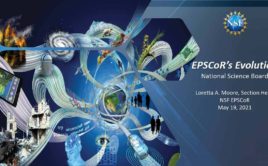
NSF EPSCoR presented at 472nd meeting of the National Science Board
The 472nd meeting of the National Science Board was held in May via teleconference. Chair Ellen Ochoa presided over the meeting. Day two’s agenda included a presentation entitled “EPSCoR’s Evolution” by Loretta Moore, NSF Section Head. NSB is interested in taking a fresh look at EPSCoR as the Board looks at ways to develop the nation’s STEM talent and expand the geography of innovation. The EPSCoR discussion starts at 3:41:49 and ends at 4:09:19. Note that this recording only includes sessions that were open to the public.

NASA Announces 2021 BIG Idea Collegiate Challenge
NASA’s 2021 Breakthrough, Innovative and Game-changing (BIG) Idea Challenge is an engineering design competition supporting NASA’s Space Technology Mission Directorate’s Game Changing Development Program’s efforts to rapidly mature innovating and high-impact capabilities and technologies for infusion in a broad array of future NASA missions. The 2021 BIG Idea Challenge is open to teams of five to 25 students from Space Grant-affiliated colleges/universities. Teams are asked to submit robust proposals for near-term dust mitigation (or dust tolerant) technologies that could be used for lunar applications near or in the Moon's South Pole. More
DOE Launches 2022 Geothermal Collegiate Competition
Organized by the National Renewable Energy Laboratory and funded by DOE’s Geothermal Technologies Office, this national competition encourages students to develop innovative solutions for geothermal applications through a year-long project that engages collegiate school teams to analyze geothermal energy for a community or campus application.