Research Highlights
KENTUCKY: NIH-funded research finds telehealth supports retention in treatment for opioid use disorder
Starting buprenorphine treatment for opioid use disorder through telehealth was associated with an increased likelihood of staying in treatment longer compared to starting treatment in a non-telehealth setting, according to a new study analyzing Medicaid data from 2019-2020 in Kentucky and Ohio. Published in JAMA Network Open, these findings add to a growing body of evidence demonstrating positive outcomes associated with the use of telemedicine for treatment of opioid use disorder.
The research was conducted as part of the HEALing Communities Study, the largest addiction prevention and treatment implementation study ever conducted, which is supported by the National Institute on Drug Abuse (NIDA) and carried out in partnership with the Substance Abuse and Mental Health Services Administration (SAMHSA) through the National Institutes of Health’s Helping to End Addiction Long-term Initiative, or NIH HEAL Initiative.
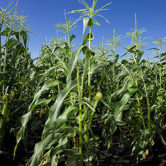
IOWA: Scientists Ratchet Up Key Amino Acid in Corn with USDA NIFA-funded Research
Experimental lines of field corn developed by a team of Agricultural Research Service (ARS) and university scientists will usher in new commercial hybrids offering high-methionine grain. The advance, reported in a recent issue of Crop Science, will be especially welcome news for organic poultry producers whose birds require dietary formulations of the amino acid to ensure optimal growth, health and production of meat and eggs.
ARS plant geneticist Paul Scott co-authored the Crop Science paper describing the advance together with other researchers including Shelley Kinney, Thomas Lübberstedt and Ursula Frei (all of Iowa State University in Ames). Project was conducted with support from USDA NIFA.
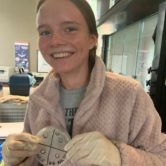
SOUTH CAROLINA: High school student doing research at Coastal Carolina University has discovered a microorganism
A high school student doing research at Coastal Carolina University has discovered a microorganism with antibiotic properties against E. coli bacteria. Writes the lab PI, Dr. Paul Richardson, “We found the organism last week, but this test proves it wasn’t chemical in nature. Now we have to isolate and identify the microorganism. This discovery was made possible through the South Carolina INBRE program.”
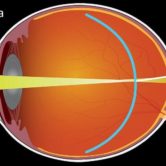
ALABAMA publishes trial about myopia in JAMA Ophthalmology
Use of low-dose atropine eyedrops was no better than placebo at slowing myopia (nearsightedness) progression and elongation of the eye among children treated for two years, according to a randomized controlled trial conducted by the Pediatric Eye Disease Investigator Group and funded by the NIH National Eye Institute. Results were published in JAMA Ophthalmology.
“It's possible that a different concentration of atropine is needed for US children to experience a benefit,” noted the study’s lead co-author, Katherine K. Weise, University of Alabama at Birmingham. “Clinical researchers could evaluate new pharmaceuticals and special wavelengths of light in combination with optical strategies, like special glasses or contact lenses, to see what works in reducing the progression of myopia.”
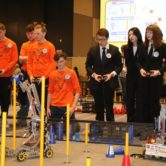
KENTUCKY: KY FIRST ROBOTICS – BREAKING BARRIERS IN STEM EDUCATION
Kentucky NSF EPSCoR is proud to partner with KY FIRST® Robotics to help fund and support instructional curriculum for their First Tech Challenge program, for grades 7-12. KY FIRST Robotics is a “progression of robotics competitions for kids, beginning with the youngest innovators and going through high school… FIRST encourages it participants to think outside the box.”
KANSAS: NSF MAPS project reaches 16 middle school science teachers
16 middle school science teachers will visit the University of Kansas Field Station to explore resources and gain new ideas to take into their classrooms. The teachers serve in school districts representing a diversity of students, both urban and rural. The Summer Institute is part of an NSF EPSCoR project funded through a $20 million grant announced in 2017. The NSF project, “Microbiomes of Aquatic, Plant, and Soil Systems across Kansas (MAPS),” RII Track-1 Award, is a collaboration among five Kansas universities. Matching support comes from the state of Kansas through the Kansas Board of Regents.
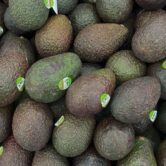
SOUTH DAKOTA: SDSU and USDA NIFA Avocado Research Study
Can avocado peels help curb a plastic waste problem? According to a study conducted by Srinivas Janaswamy, an associate professor in South Dakota State University's Department of Dairy and Food Science, and Shafaet Ahmed, a graduate research assistant working under Janaswamy's tutelage, the fibers of avocado peels could possibly be used to make biodegradable films — something that could ultimately replace plastic as a packaging material. Funding for this project was provided by the USDA NIFA. This study was published in Industrial Crops and Products.
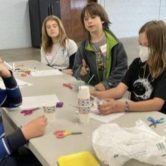
VERMONT: NSF EPSCoR and the Vermont 4-H program presented Science Fun Day
Vermont NSF EPSCoR and the Vermont 4-H program presented Science Fun Day, a two-hour-long set of activities for elementary students of grades 3-5. Event focused on hands-on STEM activities that helped students apply scientific learning to many different projects.
NM, PR, WV: New study by collaborative team and NSF's NANOGrav
You can't see or feel it, but everything around you — including your own body — is slowly shrinking and expanding. It's the weird, spacetime-warping effect of gravitational waves passing through our galaxy, according to a new study by a team of researchers with the NSF’s NANOGrav Physics Frontiers Center. The findings published in The Astrophysical Journal Letters are from the North American Nanohertz Observatory for Gravitational Waves (NANOGrav), a collaborative team of researchers from more than 50 institutions in the US and abroad.
“These are by far the most powerful gravitational waves known to exist,” said West Virginia University astrophysicist Maura McLaughlin, co-director of the NANOgrav Physics Frontiers Center. “Detecting such gargantuan gravitational waves requires a similarly massive detector, and patience.”
Using 15 years of astronomical data recorded by radio telescopes at NSF-supported observatories — including Green Bank Observatory in West Virginia, the Very Large Array in Socorro, New Mexico, and Arecibo Observatory in Puerto Rico— the NANOGrav team created a "detector" of 67 pulsars distributed all across the sky and compared the ticking rate of pairs of those pulsars. Through a sophisticated data analysis, they deduced the presence of the gravitational wave background causing the distortion of space, and thus explained the apparent timing changes of the pulsars.