IOWA: Scientists Ratchet Up Key Amino Acid in Corn with USDA NIFA-funded Research
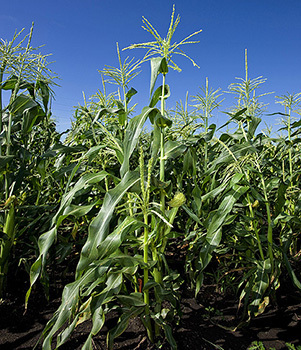
Experimental lines of field corn developed by a team of Agricultural Research Service (ARS) and university scientists will usher in new commercial hybrids offering high-methionine grain. The advance, reported in a recent issue of Crop Science, will be especially welcome news for organic poultry producers whose birds require dietary formulations of the amino acid to ensure optimal growth, health and production of meat and eggs.
ARS plant geneticist Paul Scott co-authored the Crop Science paper describing the advance together with other researchers including Shelley Kinney, Thomas Lübberstedt and Ursula Frei (all of Iowa State University in Ames). Project was conducted with support from USDA NIFA.
ARS plant geneticist Paul Scott and colleagues combined the use of two conventional plant breeding methods—namely, doubled haploid induction and recurrent selection.
Using these methods, they developed 16 lines of inbred corn whose methionine grain levels equaled—and in one case, surpassed—that of B101, a hybrid that has been shown to be a useful benchmark of comparison because of its naturally high concentration of methionine. “B101 usually measures about 0.29 grams of methionine per 100 grams of grain, and our best lines have about 0.37 grams per 100 grams,” said Scott, with the ARS Corn Insects and Crop Genetics Research Unit in Ames, Iowa.