DOE to Support Clean Energy Transition in 12 Remote and Island Communities
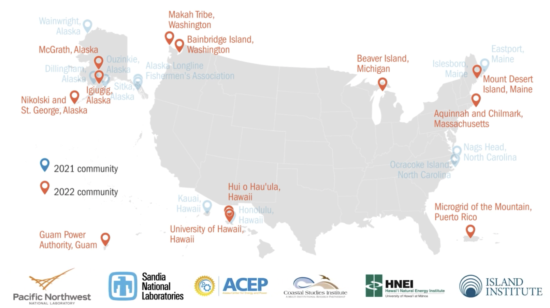
The DOE has announced it will work with 12 competitively selected remote and island communities around the United States to help strengthen their energy infrastructure, reduce the risk of outages, and improve their future energy and economic outlook. Through the Energy Transitions Initiative Partnership Project (ETIPP), DOE and its national and regional partners will support projects in communities that, due to their geographic isolation, often face high energy costs and vulnerable energy infrastructure due to their increased risk of natural disasters and climate change. ETIPP will leverage the world-class expertise of DOE's experts and National Labs to advance local clean energy solutions and improve resilience for the 12 selected communities which, like other remote and island areas, often lack the financial resources and the access to experts to plan a clean energy transition. Selected communities in EPSCoR jurisdictions are:
- ALASKA:
- The Igiugig community is receiving assistance to analyze electricity distribution efficiency, energy conservation, and impacts to the grid from increased renewables. The project will work with the Tribal Council to also increase communication and community engagement for energy transition issues. Outcomes will help Igiugig move toward its goal of improving energy self-sufficiency by using local, renewable resources and its own workforce while minimizing environmental impact and maintaining its cultural identity.
- With ETIPP technical assistance, McGrath (in landlocked central Alaska) aims to increase its energy independence and resilience while reducing the cost of energy. This project will assess the potential for renewable energy in the area, including hydrokinetic, wind, solar, green hydrogen, and micro-nuclear resources. This project will also aim to leverage local economic opportunities through capacity-building efforts within the community.
- In Nikolski, Alaska (on Unmak Island in the West Aleutian Islands) and in St. George, Alaska (an island a few hundred miles north), assistance will go toward assessing the condition of existing wind turbines and plans to reconfigure them with a new mix of renewable energy resources. In addition to helping reduce each community’s reliance on costly imported diesel, this project will train local staff in equipment maintenance and assess the viability of battery storage.
- GUAM: The Guam Power Authority (GPA) is seeking assistance with renewable energy resource integration, improved utility planning and energy security, and to establish a performance management system for its Clean Energy Master Plan. These efforts support GPA’s commitment to Guam’s ambitious renewable energy goals, which mandate 50% renewable generation by 2035 and 100% by 2045.
- HAWAI‘I:
- Hui o Hau’ula, a community organization of Oahu, is coordinating the planning and development of a Community Resilience Hub, which will include the generation and storage of power for the surrounding Koolauloa District. To achieve this, Hui o Hau’ula is seeking assistance to assess energy needs and evaluate a portfolio of renewable energy technologies for the Resilience Hub. The project will develop technical guidance and documentation for storm and disaster energy resilience throughout Koolauloa.
- The University of Hawaii’s project plans include analyzing the potential for geothermal cooling in buildings across its 10 campuses. The project will model shallow geologic conditions and building heating and cooling loads at each campus to recommend geothermal technologies, materials, and design approaches that improve energy efficiency and significantly increase sustainability across campus communities. Outcomes will include increased capacity for geothermal energy analysis at the University and opportunities to apply project results in similar environments.
- MAINE: Mount Desert Island’s goal for its technical assistance is understanding optimal approaches to transition its grid to clean energy while increasing energy resilience and community capacity. The project will assess opportunities for renewable energy integration, energy storage and efficiency, and the viability of a microgrid to make the island resilient during extreme weather events. Results from this project will support future decarbonization plans for the area.
- PUERTO RICO: A hydroelectric cooperative in Puerto Rico will employ ETIPP assistance to refine its intermunicipal microgrid plan, and develop and design specifications for batteries, distribution, and other improvements. The project will also support the cooperative’s technical review data related to implementation of the new system. The project will help the cooperative deliver affordable, resilient energy for residents across four remote, inland mountain communities.