News & Updates
University of Kentucky Research Team Has Work Highlighted in AAAS' Science Journal
A group of University of Kentucky professors and scientists’ efforts to identify possible direct therapeutic approaches to treat COVID-19 was published in the Perspectives section of the most recent issue of Science, a journal of the American Association for the Advancement of Science (AAAS). "Rapid repurposing of drugs for COVID-19," is authored by Kip Guy, dean of UK College of Pharmacy; Robert DiPaola, dean of the UK College of Pharmacy; Frank Romanelli, professor in the UK College of Pharmacy; and Rebecca Dutch, professor in the UK College of Medicine. The article details the approach to repurpose approved drugs that are currently developed for other uses.
University of Louisville researchers addressing urgent need for knowledge about COVID-19
If the SARS-CoV-2 virus is to be contained and cases of COVID-19 controlled, more knowledge is needed about how the virus is spread, who becomes ill and how the illness progresses. The University of Louisville is already at work to answer these urgent questions to reduce the impact of the global pandemic.
University of Louisville breakthrough technology shows promise fighting novel coronavirus
University of Louisville researchers have developed a technology that is believed to block the novel coronavirus SARS-CoV-2 from infecting human cells. The technology is based on a piece of synthetic DNA – an “aptamer” – which targets and binds with a human protein called nucleolin. Early tests show that this aptamer may stop viruses, including novel coronavirus, from “hijacking” nucleolin to replicate inside the body. UofL is seeking to fast-track development, including application to the Food and Drug Administration for approval to start treating patients seriously affected with COVID-19.
University of Louisville delivering health care through a new lens: smart glasses
The COVID-19 pandemic has led to the expansion of telemedicine, and as part of that expansion, faculty at the University of Louisville are piloting new smart glasses for advanced delivery of health care. Long-term care facilities and emergency departments represent two of the areas with greatest need for the glasses for direct physician care during the pandemic. The UofL Trager Institute, emergency medicine and psychiatry are part of a feasibility study to test the Vuzix M400 smart glasses.
University of Louisville researchers seek new drugs to fight coronavirus using computers in Kentucky schools
The coronavirus may have K-12 students in Kentucky’s school districts learning at home, but researchers at the University of Louisville are using the computing power of thousands of computers in classrooms across the state to identify drugs to treat COVID-19. The desktop computers are part of the DataseamGrid, a network of computers housed in classrooms of 48 Kentucky school districts as part of a partnership designed to support research, education and workforce development.
University of Louisville launches decontamination program to alleviate mask shortage for health care workers
The University of Louisville is offering a program to decontaminate used N95 respirators, boosting the supply of masks for local health care providers, first responders and community organizations such as nursing homes at no charge. The N95 Decontamination Program, announced April 11 by Louisville Mayor Greg Fischer, will begin next week, sterilizing up to 7,000 N95 masks per day using vaporized hydrogen peroxide (VHP). This process has been validated by Battelle Memorial Institute as a way to allow the masks to be reused safely by health care workers.
University of Louisville developing robot to disinfect areas with coronavirus risk
Many doctors, nurses, EMTs and other health care workers have risked infection while fighting the coronavirus pandemic. But researchers at the University of Louisville think they have a solution that could help reduce that risk. The idea is to use an artificially intelligent robot they call ARNA — Adaptive Robot Nursing Assistant — to perform some tasks and cleaning in areas where it might be dangerous to send human hospital staff. The bot has been outfitted with an ultraviolet disinfecting light and sprayable sanitizing agent so it can clean commonly touched surfaces where the virus might live, such as handles, tables and elevator buttons.
University of Vermont Engineers Taking On the Ventilator Shortage
On Monday, March 9th, Jake Kittell, a research engineer and machinist who builds scientific equipment for the University of Vermont, in Burlington, came into work fired up. Approaching another engineer, Carl Silver, he said, “We gotta build a ventilator.”
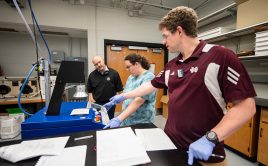
Mississippi State University research center tests materials as Mississippi companies transition to manufacturing masks
As Mississippi’s manufacturers begin producing supplies to aid in the state’s COVID-19 response, Mississippi State researchers are helping them assess the filtering capabilities of their materials.
Mississippi State University faculty use 3D printers to produce face shields for Meridian medical personnel
With personal protective equipment in short supply nationwide, a team of engineers and researchers at Mississippi State University is turning to an unlikely combination of 3D printers and office supplies to aid medical personnel tackling COVID-19.