News & Updates
University of Louisville researchers seek new drugs to fight coronavirus using computers in Kentucky schools
The coronavirus may have K-12 students in Kentucky’s school districts learning at home, but researchers at the University of Louisville are using the computing power of thousands of computers in classrooms across the state to identify drugs to treat COVID-19. The desktop computers are part of the DataseamGrid, a network of computers housed in classrooms of 48 Kentucky school districts as part of a partnership designed to support research, education and workforce development.
University of Louisville launches decontamination program to alleviate mask shortage for health care workers
The University of Louisville is offering a program to decontaminate used N95 respirators, boosting the supply of masks for local health care providers, first responders and community organizations such as nursing homes at no charge. The N95 Decontamination Program, announced April 11 by Louisville Mayor Greg Fischer, will begin next week, sterilizing up to 7,000 N95 masks per day using vaporized hydrogen peroxide (VHP). This process has been validated by Battelle Memorial Institute as a way to allow the masks to be reused safely by health care workers.
University of Louisville developing robot to disinfect areas with coronavirus risk
Many doctors, nurses, EMTs and other health care workers have risked infection while fighting the coronavirus pandemic. But researchers at the University of Louisville think they have a solution that could help reduce that risk. The idea is to use an artificially intelligent robot they call ARNA — Adaptive Robot Nursing Assistant — to perform some tasks and cleaning in areas where it might be dangerous to send human hospital staff. The bot has been outfitted with an ultraviolet disinfecting light and sprayable sanitizing agent so it can clean commonly touched surfaces where the virus might live, such as handles, tables and elevator buttons.
University of Vermont Engineers Taking On the Ventilator Shortage
On Monday, March 9th, Jake Kittell, a research engineer and machinist who builds scientific equipment for the University of Vermont, in Burlington, came into work fired up. Approaching another engineer, Carl Silver, he said, “We gotta build a ventilator.”
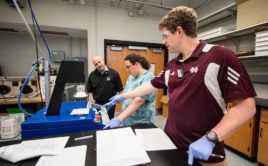
Mississippi State University research center tests materials as Mississippi companies transition to manufacturing masks
As Mississippi’s manufacturers begin producing supplies to aid in the state’s COVID-19 response, Mississippi State researchers are helping them assess the filtering capabilities of their materials.
Mississippi State University faculty use 3D printers to produce face shields for Meridian medical personnel
With personal protective equipment in short supply nationwide, a team of engineers and researchers at Mississippi State University is turning to an unlikely combination of 3D printers and office supplies to aid medical personnel tackling COVID-19.
Mississippi State University students turn toolbox into UV mask sterilizer for campus health center
Mississippi State University mechanical engineering students have turned a conventional truck toolbox into a device that will sterilize face masks for the university’s John C. Longest Student Health Center staff. A team of two students, under the leadership of researchers at MSU’s Center for Advanced Vehicular Systems, built and tested the device before delivering it to the health center on Monday [April 13]. Built using low-cost materials, the device can sterilize 15-20 masks in minutes, filling a need for the health center during the COVID-19 pandemic and a nationwide shortage of masks.
Omaha medical researcher says he's excited about results of COVID-19 drug trial
In a major international study that enrolled its first patient at the Nebraska Medical Center, the experimental drug, called remdesivir, shortened the time it takes for patients to recover by four days on average, U.S. government and company officials announced Wednesday. Gilead Sciences’ drug is the first treatment to pass such a stringent test against the virus, which has killed more than 218,000 people since it emerged late last year in China. The drug also showed a trend toward fewer deaths in patients who were ill enough to have lung involvement.
West Virginia Scientists produce solution needed for COVID-19 testing
A team of scientists, pathologists and lab technicians from Marshall University and Mountain Health Network are helping West Virginia address a limited supply of the solution used to transport testing swabs for the novel coronavirus (COVID-19) by making the mixture in one of the university’s labs. The clear viral transport medium (VTM), composed of specialized reagents, keeps a virus viable on the nasopharyngeal swab for transport until testing is performed.
Marshall University’s Robert C. Byrd Institute ramps up production of protective equipment
The Robert C. Byrd Institute (RCBI) at Marshall University is working around the clock to produce personal protective equipment as part of the fight to reduce the spread of the corona virus. Technicians in Charleston and Huntington are manufacturing N95 masks and face shields using RCBI’s stable of 3D printers and laser cutting technology, including one of the largest 3D printers in the state. The devices are being shipped to the West Virginia Army National Guard in Charleston where the face shields are assembled, and filters are added to the N95 masks before they are distributed around the state to health care workers and first responders.