NIH Chief Defends Funding Shift to States like Nebraska, Iowa During Visit to Massachusetts
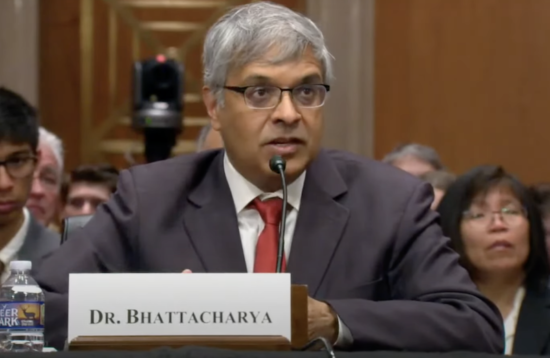
BOSTON — National Institutes of Health Director Jay Bhattacharya defended the agency’s plan to distribute more research dollars to underfunded regions during a visit to Massachusetts on Friday, telling scientists that institutions across the country should be able to compete on equal terms with the state’s powerhouse research centers.
Bhattacharya said the shift toward “geographic balance” is intended to strengthen research capacity in states such as Iowa, Nebraska and Alabama, not to diminish support for Massachusetts, which receives more NIH funding per capita than any other state.
“I don’t see a future with Massachusetts not having support,” he said, adding that he hopes other states can share in the kind of success long seen in the state’s biomedical sector.
His visit included meetings with researchers, biotech officials and members of the state’s all-Democratic congressional delegation, who raised concerns about layoffs, canceled clinical trials and a decline in the number of funded research proposals. Many of those gathered pushed back on the agency’s claim that overall funding levels remain stable, saying the scientific workforce is feeling the impact of fewer awards.
At MIT, one Boston Medical Center physician told Bhattacharya that halted studies, hiring freezes and stalled training pipelines pose “an existential threat” to the next generation of researchers. The comment drew loud applause from attendees.
Bhattacharya responded that the agency intends to continue investing in early-career scientists.
Members of Congress, including Rep. Jake Auchincloss (D-MA) and Rep. Richard Neal (D-MA), invited Bhattacharya to Massachusetts in part to emphasize the state’s outsized role in biomedical innovation. Neal said the delegation wants to ensure any changes to NIH spending are driven by scientific policy rather than political considerations.
Auchincloss said the message from local researchers was clear: funding should reward scientific merit. “This wasn’t about Massachusetts saying Massachusetts wants more money,” he said. “This was about great scientists representing great scientific institutions saying we want the best science to win.”
Leaders from MassBio and UMass Chan Medical School echoed concerns about disrupted research programs. UMass Chan Chancellor Dr. Michael Collins warned that the school’s NIH funding could fall from about $300 million to below $220 million this year, putting pressure on senior and early-career investigators who failed to secure awards.
The disruptions follow a brief but dramatic funding freeze earlier this year that hit Harvard University harder than any other institution. Nearly $3 billion in grants were withheld after the Trump administration accused the university of tolerating antisemitism, though most funds were restored following a federal court ruling.
Bhattacharya said he wants NIH to become more competitive and more focused on research that yields measurable results. He told lawmakers in June that 60% to 65% of NIH’s budget goes to roughly 20 universities, a distribution he believes should be broadened.
A prominent critic of COVID-19 lockdowns during the pandemic, Bhattacharya has promoted the phrase “Make America Healthy Again,” echoing language from Health Secretary Robert F. Kennedy Jr. He said he does not personally see a link between vaccines and autism but argued that more studies may be needed to address the public's "tremendous distrust" in medical science since the outbreak of the COVID-19 pandemic.
Bhattacharya also said NIH will continue supporting research on health disparities but emphasized that such studies should seek to improve minority health rather than be "ideologically focused."
Asked whether the rapid changes at NIH trouble him, given their impact on colleagues and collaborators in the scientific community, Bhattacharya said he remains focused on long-standing health challenges.
“I have no problem sleeping because I can see that the investments we’ve made, which have led to tremendous advances in biological knowledge, have not translated over to improving the life expectancy of Americans since 2010,” he said. “What I see myself doing is helping the institutions of this country refocus on ... excellent science that makes people’s lives better.”