IDeA Program Discussed During Budget Hearing
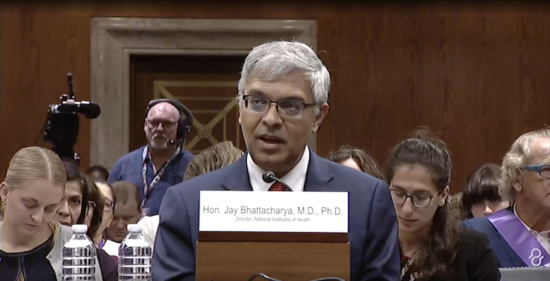
Last Tuesday, the Senate Appropriations Labor, Health and Human Services, Education, and Related Agencies Subcommittee held a hearing on the Trump Administration’s FY26 budget request for the National Institutes of Health (NIH).
The IDeA program was mentioned in the first few minutes of the hearing by Subcommittee Chair Senator Capito (R-WV) during her opening statement (time stamp 16:22-16:37). Senator Capito also asked NIH Director Dr. Jay Bhattacharya about the IDeA program at 47:54 and asked that the “developmental awards” be increased. In his answer, the NIH Director noted that IDeA program was a small fraction of NIH funding and “is less funded than it ought to be.” He stated that he wanted to work with Congress to ensure that NIH funding is more “geographically dispersed than it currently is.”
Chair of the full Senate Appropriations Committee Senator Collins (R-ME) brought up the 15% cap on NIH F&A in her questions (38:08) and noted that the cap proposed by the Administration is against federal law. She mentioned meeting with Kelvin Droegemeier who offered two possible models for F&A which are “far fairer.”
Senator Britt (R-AL) also engaged in an interesting line of questioning with Dr. Bhattacharya around F&A (1:20:35). The NIH Director stated during this exchange that “we have a system that guarantees that a very small number of universities are going to get all of the institutional overhead” and that “we have to make sure that institutional overhead funds are essentially part of a competition across universities.” He noted that the “key problem now is that we require that the institutions have excellent researchers in order to get the institutional support,” creating a “vicious cycle” because “you only attract excellent researchers if you have the institutional support, the lab space...” Senator Britt asked how to break the cycle and Dr. Bhattacharya mentioned the IDeA program (1:21:20) in his answer.
Senator Britt went on to ask “if we introduce competition into this arena…if we introduce it into the indirect cost equation…how would that actually bolster, or do you think that would break the system?” To that, the NIH Director responded, “…I think that would actually strengthen the system because it would get support to researchers that are in nontraditional places but have excellent ideas…and I think that combats scientific group think, expands the base of scientific ideas and really addresses the critical roadblocks that we currently face.”
Senator Rounds (R-SD) addressed F&A (1:32:42) by stating that there is “real value in looking at smaller institutions as well and providing an opportunity for them to participate and compete for the grant funding coming out of NIH and I think you may find that their overhead may be substantially less.” He went on to give an example of a smaller institution needing a larger computer system, that might be considered overhead but is also really needed for the purposes of an experiment.
Other Senators from IDeA states at the hearing included Senator Shaheen (D-NH) and Senator Schatz (D-HI).
Throughout the hearing, Members of the Subcommittee raised serious concerns about the proposed $18 billion cut, roughly 40% of the NIH’s budget, and its implications for medical innovation, clinical trials, and the U.S. biomedical research workforce. Senators highlighted that this proposal would not only slow progress on new cures but could actively reverse years of investment. Senator Murray (D-WA) stated that the Administration “has fired or pushed out 5,000 critical employees across NIH, prevented $3B in grant funding from being awarded and terminated 2,500 grants totaling almost $5B.” She went on to say, “Research institutions have been waiting months for funding that has already been awarded."