NASA Announces 60 Teams for 2022 Student Launch Competition
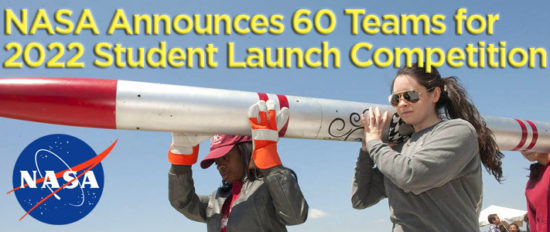
NASA has announced the 60 teams from 22 states and Puerto Rico selected to compete in the 2022 Student Launch – one of seven Artemis Student Challenges.
The nine-month challenge provides a realistic experience for middle school, high school, and college students to follow the engineering design process NASA and industry engineers use when developing and operating new hardware.
The student teams are required to design, build, test, and fly a payload and high-powered amateur rocket to an altitude between 3,500 and 5,500 feet. Teams also must meet multiple documentation and presentation milestones with NASA experts as they develop their rocket. The reports often total hundreds of pages of work by the end of the competition year.
Teams in the college/university division will tackle a new task that mirrors NASA missions like the Mars Curiosity Rover. Teams must design a payload capable of autonomously locating where their rocket landed by identifying the rocket’s grid position on an aerial image of the launch site, while transmitting the data back to their ground station. This must be accomplished without the use of GPS. The requirement simulates a challenge faced by NASA mission managers.
Middle and high school teams can choose to attempt the college/university division challenge or develop their own science or engineering experiment. College and University Division NASA EPSCoR jurisdiction teams include:
- ALABAMA: Auburn University; University of Alabama in Huntsville; The University of Alabama, Tuscaloosa; University of South Alabama
- IOWA: Iowa State University
- LOUISIANA: Dillard University
- NORTH DAKOTA: University of North Dakota, Grand Forks
- PUERTO RICO: University of Puerto Rico, Mayagüez Campus
Middle, High School and Informal Education Institution Division NASA EPSCoR jurisdiction teams include:
- IOWA: Cedar Falls High School; Webster City High School