Success Stories
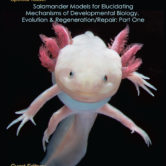
MAINE: COBRE research featured on journal cover
Research partially funded by the MDI Biological Laboratory IDeA COBRE Comparative Biology of Tissue Repair, Regeneration, and Aging was featured as the cover of Developmental Dynamics.
The axolotl: a classical and robust model of tissue regeneration. From: Gene and transgenics nomenclature for the laboratory axolotl, Ambystoma mexicanum; Sergej Nowoshilow, Ji-Feng Fei, S. Randal Voss, Elly M. Tanaka, Prayag Murawala; (Photo credit: IMP-IMBA Graphics Department)
ABSTRACT: The laboratory axolotl (Ambystoma mexicanum) is widely used in biological research. Recent advancements in genetic and molecular toolkits are greatly accelerating the work using axolotl, especially in the area of tissue regeneration. At this juncture, there is a critical need to establish gene and transgenic nomenclature to ensure uniformity in axolotl research. Here, we propose guidelines for genetic nomenclature when working with the axolotl.
Read the research article

ARKANSAS: Arkansas receives new NSF EPSCoR RII Track-1 project, DART
July 1, 2020 marked the first day of a five-year statewide collaborative research project, “Data Analytics that are Robust and Trusted: From Smart Curation to Socially Aware Decision Making” (DART). This project will investigate key aspects of three barriers to practical application and acceptance of modern data analytics. Those three barriers are the management of big data, the security or privacy of big data, and interpretability of the models used to understand big data.
This project was funded by the National Science Foundation Established Program to Stimulate Competitive Research (NSF EPSCoR) at $20M and included a $4M cash match from the State. The goal of the NSF EPSCoR program is to build research infrastructure and competitiveness among states that receive a small overall percentage of NSF grants. EPSCoR was created in 1979 at NSF and expanded over the following years to the National Institutes of Health (NIH), Department of Defense (DOD), Department of Agriculture (USDA), National Aeronautics and Space Administration (NASA), and the Department of Energy (DOE).
Arkansas has successfully competed for NSF EPSCoR Track-1 grants for decades. These grants have purchased major equipment and instruments (like a 3d printer that prints at nanoscale), dramatically improved the state’s cyberinfrastructure, and supported hundreds of scientific researchers who in turn have published hundreds of scientific papers and secured millions more in research funding.
ARKANSAS: UA researchers develop long-lasting disinfectant spray
Researchers with the University of Arkansas and the University of Arkansas for Medical Sciences (UAMS) have developed a disinfectant spray that can last for up to 50 touches before it needs to be reapplied.
The long-lasting spray was created using plant-based nanotechnology and contains a green dye that, when it fades, will show another application is needed.
“If it’s green, it’s clean,” said John Moore, a UA doctoral student in chemical engineering and part of the team researching the spray. Moore is also CEO of Fayetteville-based Nanocellutions, established in April by the team, including Jamie Hestekin, Peter Crooks and Soma Shekar Dachavaram. Hestekin is a professor of chemical engineering at the UA, and Crooks and Dachavaram are with UAMS.
Work that led to the development of the spray started in 2015 as part of a $20 million National Science Foundation Track 1 project led by Min Zou, mechanical engineering professor, and Steve Stanley of the Arkansas Economic Development Commission.
Read the full story from TB&P here.
How Conservation Efforts Help The Critically Endangered Nassau Grouper
Due to efforts of the U.S. Virgin Islands' community and partnerships between fishermen and scientists, we are beginning to see that the Nassau grouper, currently listed as commercially extinct, is coming back from the brink. Dr. Rick Nemeth (UVI researcher), Dan Mele (Masters in Marine and Environmental Science student at the University of the Virgin Islands (UVI)), the National Science Foundation (NSF), VI-EPSCoR, and UVI Center for Marine and Environmental Studies helped make this mini-documentary about conservation efforts regarding the Nassau grouper possible!
Read more about USVI EPSCoR’s Nassau Grouper Project here.
NASA Selects Four Arkansas Companies’ Proposals for SBIR Program
Through its Small Business Innovation Research (SBIR) and Small Business Technology Transfer (STTR) programs, NASA is planning to inject $51 million into 312 small businesses across the United States. Several of those companies are located in Arkansas.
NASA announced that four Arkansas companies have been chosen for Phase I of the SBIR project selection process. Part of NASA’s Space Technology Mission Directorate, the SBIR program is designed to stimulate innovation and encourages companies to develop ideas that will “meet the government specific research and development needs with the potential for commercialization,” according to the agency’s website.
All four of the companies are located in Northwest Arkansas’ Washington County. Three of the companies are based in Fayetteville, while one is located in Elkins, a small town approximately 13 miles southeast of Fayetteville.
The companies include: CatalyzeH20, Nanomatronix, Ozark Integrated Circuits and WattGlass.
Read the full story from Arkansas Money & Politics here.
*Ozark Integrated Circuits and WattGlass, were startups that spun out of Arkansas’ EPSCoR Track-1 in 2010-2015.
Repairing lung tissue damaged by COVID-19
A Clemson University technology-based start-up company, Elastrin Therapeutics Inc., is working to develop technologies that could prevent and repair lung damage caused by COVID-19.
COVID-19 causes airway diseases such as acute lung injury and acute respiratory distress syndrome that damage lung tissue of young and old alike. These conditions often result in chronic immunological responses that induce acute crises and damage lung tissue over time. This already is a significant health risk in the United States. Chronic obstructive pulmonary disease is the third leading cause of death in the U.S. Approximately 40-60% of all exacerbations are associated with viral infections.
One of the essential structural proteins in the lungs is elastin that provides balloon-like (elastic) properties that allow lung tissue to recoil during exhalation. Elastin rarely remodels and destruction of elastin in lungs is irreversible. Because older patients who have compromised lung function are more prone to lung damage, therapies are needed for such patients. This is especially relevant as the damage opens them to fatal episodes from infections such as coronavirus. While the immune system works to fight viral infection, we need to protect collateral lung damage, said Naren Vyavahare, co-founder of Elastrin Therapeutics and the Hunter endowed chair and professor of bioengineering at Clemson.
Vyahavare and Elastrin have developed nanoparticles with attached humanized elastin antibody that target only to degraded elastin matrix, sparing healthy tissue. As such, the nanoparticles can be targeted in fragmented elastin in disease states, making them effective for drug delivery. They are also working to develop associated drug therapies that could fill an unmet need for patients whose lung tissue could be severely damaged and who experience permanent disability.
With funding from the SCRA (formerly the South Carolina Redevelopment Authority), Elastrin and Vyavahare will advance this research and work to develop a targeted therapy to prevent the progression of acute lung injury and to protect healthy lung matrix. They’ll also test if they can repair lung tissue after the injury.
Vyahavare serves as the director of Bioengineering Center for Regeneration and Formation of Tissues (SC BioCRAFT) at Clemson University. This COBRE center is working to significantly augment collaborative efforts in South Carolina to recruit, train, and retain a critical mass of investigators with cross-disciplinary skills to collaborate effectively in the research area of regenerative medicine.
Read the full story from Clemson University here.
Arkansas lands $20 million National Science Foundation grant
The Arkansas Economic Development Commission’s Division of Science and Technology and its university partners recently won a National Science Foundation Established Program to Stimulate Competitive Research (NSF EPSCoR) Track-1 grant for $20 million to be awarded over five years. The state of Arkansas will match the grant with an additional $4 million.
The project, “Data Analytics that are Robust and Trusted” (DART) will work to systematically investigate key aspects of three barriers to big data — management, security/privacy, and model interpretability — and develop novel, integrated solutions to address them.
Read the full story from Talk Business and Politics here.
Researchers at South Dakota School of Mines and Technology Use NASA EPSCoR Funding to Develop Improved Spacesuit
Researchers at South Dakota School of Mines & Technology have entered their third year of development of a wearable and wireless body sensor system—with the ability to be powered remotely—that will revolutionize NASA spacesuits.
Roy says the research "fits seamlessly with the priorities in NASA's Human Exploration and Operations Mission Directorate and the Space Technology Mission Directorate. This project is closely relevant to NASA's Technology Roadmap TA 6: Human Health, Life Support and Habitation Systems."
Maine EPSCoR SEANET Researchers Combat Sea Lice
One major challenge to Maine’s salmon industry is salmon lice (Lepeophtheirus salmonis), which are parasites that infest both Atlantic and Pacific salmon. Salmon lice are small creatures, growing to no larger than a dime, but pose a serious threat to the health and longevity of both wild and farm-raised salmon. In Maine, sea lice are estimated to cause an average loss of $50 million a year for the salmon industry. EPSCoR SEANET funded a collaborative research project at the University of Maine’s Aquaculture Research Institute (ARI) to foster foundational biological understanding of lice as well as a plan to establish preventative vaccines.
Most studies examining the effects of temperature on sea lice consider sea lice living in waters at a temperature of around four degrees Celsius. In Maine, however, sea lice must survive winter waters at a temperature of minus two degrees Celsius. At four degrees Celsius, studies have shown that sea lice and their eggs can live up to 12 weeks. Dr. Ian Bricknell and his team hypothesize that this time could double to 24 weeks in colder water. If his research supports this hypothesis, he will have conclusive evidence that Maine’s cold waters are allowing sea lice to survive over the winter in an egg stage until the return of the salmon in the spring, reducing or even eliminating the need for an intermediate host.
Maine’s Bigelow Lab Uncovers New Patterns in Microbial Diversity
A new NSF-funded paper in the journal Cell reports a staggering degree of biological diversity that defies contemporary definitions of microbial species and illuminates reasons behind challenges in metagenomic studies. The research may further understanding of how marine microbes respond to climate change.
"This unprecedented project uses a big data approach to read a large, randomized sample of genomes from the global microbiome, which we then explore to answer many types of questions. Our team’s results provide a deeper understanding of microbial diversity in the ocean, new insights into energy sources and biosynthetic capabilities, and novel tools for the study of microbes in all environments." ~ Ramunas Stepanauskas, senior author of the paper. "
The researchers analyzed more than 12,000 individual microbial genomes to build the Global Ocean Reference Genomes Tropics database. To their surprise, every cell they analyzed was genetically unique. In fact, few were similar enough that they would be considered the same species.
This new perspective on microbial diversity incorporates both local and global scales. The team used cutting-edge technologies in the Bigelow Laboratory's Single Cell Genomics Center to analyze samples collected throughout the tropics and subtropics -- two thirds of the world's oceans -- to learn about global distribution patterns. They also examined local microbial diversity by reading the blueprints of more than 6,000 individual cells in a single teaspoon of water from the Sargasso Sea.
Read the full article from Bigelow Lab here.