NORTH DAKOTA: Equipment at Minot State University supports workforce development for North Dakota
An ideal thickness for studying certain rocks and minerals underneath a microscope is 0.03 mm, or roughly one one-thousandth of an inch (also known as one thou). Put another way, it takes 1,000 thous to make one inch.
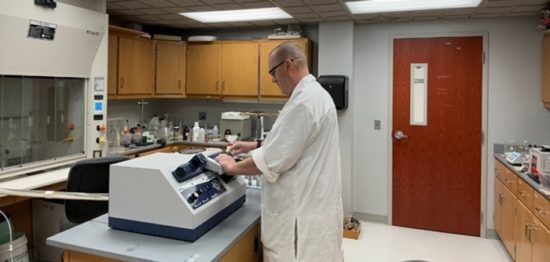
Dr. John Webster, a Geosciences researcher and professor at Minot State University, received almost $33,000 from ND EPSCoR's STEM Research and Education program in 2022 to purchase a new precision thin-section machine that cuts stones thin enough for him and his students to discern mineral and chemical composition. ND EPSCoR's STEM Research and Education program is funded through appropriated funds from the ND state legislature to support STEM across North Dakota.
The Buehler PetroThin, as it’s called, is a thin section machine with a PetroBond thin section fixture that ensures parallelism of cutting and grinding procedures. The technology that creates thin sections isn’t new, but it’s essential to the work Webster performs as both a researcher and a lecturer. Thin-section study using a petrographic microscope is the standard technique for detailed study of rocks and minerals. It helps researchers describe rocks in great detail, including their mineral composition to better understand how they formed.
“It allows us to characterize rocks in new ways and interpret how rocks were formed,” Webster said. “It really is a fundamental, really important approach to studying geological materials. Even if we have good hand lenses (magnifiers), it’s difficult to identify minerals and see the textures. With thin slices like this, it really is how we characterize rocks and understand what they're made of in terms of minerals.”