NEBRASKA: NSF CAREER award helps EPSCoR researcher advance work on cell-cell junctions and their link to human health
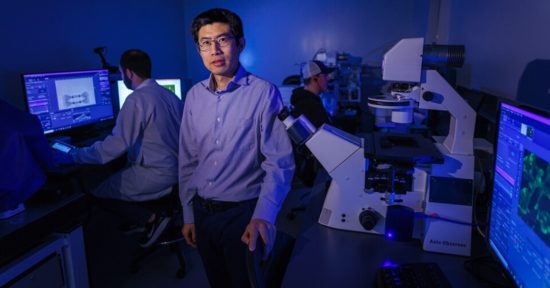
A $540,000 NSF Faculty Early Career Development Program (CAREER) grant allows Ruiguo Yang, a former Nebraska EPSCoR FIRST Award recipient and University of Nebraska-Lincoln assistant professor of mechanical and materials engineering, to examine how cell-cell junctions — the protein structures that enable cells to attach to neighboring cells — respond to the wide range of strains they're subjected to every day, such as cardiac pulses, stretching of the skin and peristalsis in the gut.
Yang’s work is innovative for its position at the intersection of biology and engineering. To this point, there has been significant focus on how cells connect to their extracellular matrix — the protein bed on which they’re anchored. That’s because the method for studying those linkages falls squarely into traditional bioengineering approaches: Researchers can replicate those connections easily by throwing cells into a dish with media that mimics the extracellular matrix. But representing cell-to-cell junctions is much more difficult, which is why Yang’s fabrication of the cell bridge platform was pivotal for this next phase of work.