DELAWARE: Building Leaders, Strengthening the Workforce
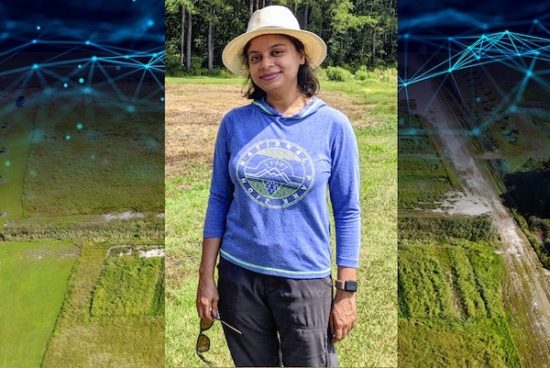
Pinki Mondal, associate professor of geography and spatial sciences at the University of Delaware, uses remote sensing to study the creeping reach of saltwater in Delaware, through seed funding from the Established Program to Stimulate Competitive Research (EPSCoR). Delaware EPSCoR and the Delaware IDeA Network of Biomedical Research Excellence (DE-INBRE) are programs that serve as “on ramps to bigger ideas, bolder collaborations and sustained research trajectories,” according to UD’s Fabrice Veron, interim vice president for research, scholarship and innovation.
Photo by Maria Errico and courtesy of Pinki Mondal and Gulni Ozbay
EPSCoR, INBRE funding serve vital role in Delaware STEM research workforce and biomedical research
Using satellites orbiting hundreds of miles above Earth, Pinki Mondal is tracking changes on the ground.
An associate professor of geography and spatial sciences at the University of Delaware, Mondal uses remote sensing to study shifting landscapes in India, Vietnam and Sierra Leone — and now, through seed funding from the Established Program to Stimulate Competitive Research (EPSCoR), the creeping reach of saltwater in Delaware.
Saltwater intrusion is a global process that manifests locally, when fresh water and seawater meet in surface estuaries or underground, causing fresh water to become saltier. In a coastal state like Delaware, this can be particularly problematic for agriculture, leading to saltier soils and declining crop yields.
Mondal and a team of students collected images and data points to understand the problem from both a large- and fine-scale lens and ultimately developed an app to map salt patches that can occur when high salinity is present on coastal farmlands. She discussed the work, which has the potential to inform researchers, farmers and community members alike, at the inaugural statewide research symposium hosted by Delaware EPSCoR and the Delaware IDeA Network of Biomedical Research Excellence (DE-INBRE), held April 10 on UD’s Science, Technology and Advanced Research (STAR) Campus.
While the research is ongoing, the value of such seed funding for this project can be found in the data, Mondal said.
“If we look at just the numbers, this little pot of seed money supported five graduate students and eight new projects. It resulted in six journal articles and four data sets so far, as well as 19 media mentions and 35 conference presentations, mostly led by the graduate students,” said Mondal, who also is a resident faculty member in UD’s Data Science Institute.