MAINE: INBRE Biology Students + Crickets + High Performance Computers = Scientific Breakthrough
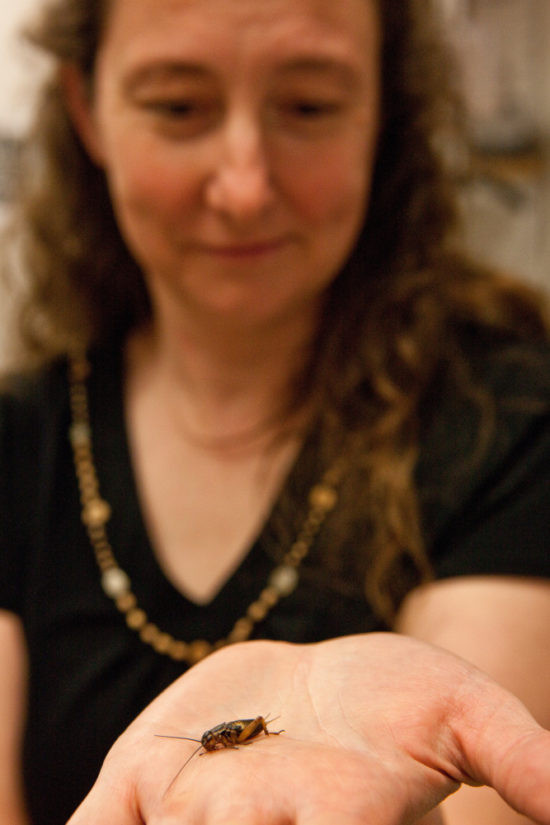
Bowdoin College professor Hadley Horch, PhD, has collaborated with the Maine INBRE Bioinformatics Core to advance her research and provide cutting-edge student training opportunities in computational biology.
Horch, her neurobiology students, and core bioinformaticians, with the support of Bowdoin’s high-performance computer cluster, took on the project of creating the largest existing transcriptome of the field cricket, an animal that has the remarkable ability to neurologically compensate for the loss of a sensory organ.
"It is ambitious what we're trying to do," Horch said. "And we have more plans, too, after we build this." They will use the information they piece together to search for possible biological pathways behind the cricket's remarkable ability to compensate for the loss of a sensory organ.
"I’m personally really interested in molecular biology; recent advances in molecular research methods have made it possible to pursue answers to so many cool and interesting questions. To understand modern research in neuroscience, it’s necessary to keep up with the cutting edge of these methods. I’m also really interested in neurological and psychiatric disorders, like Angelman’s, Alzheimer’s, and Parkinson’s; these are molecular disorders. To understand how to treat and cure them, I need to gain the skills to work in molecular biology. I’m gaining those skills in Molecular Neuro." — Anthony Yanez ’22