IOWA: Four glaciologists create new glacier “slip law”
Glaciologists measure, model glacier beds, develop 'slip law' to estimate glacier speeds
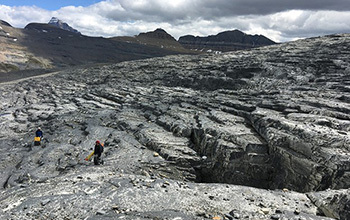
Researchers measure Castleguard Glacier in the Rocky Mountains of Alberta, Canada.
Photos show the hard, rough country some glaciers slide over: rocky domes and bumps in granite, rocky steps and depressions in limestone. The glaciers' beds often dwarf the researchers and their instruments.
During research in places exposed by retreating glaciers in the Swiss Alps (Rhone, Schwarzburg and Tsanfleuron glaciers) and the Canadian Rockies (Castleguard Glacier), four glaciologists used laser and drone technology to precisely measure the glaciers' rocky beds and record their contours.
The scientists then turned their measurements into high-resolution digital models of the glacier beds. They worked with subunits of the models to study how glaciers slide along bedrock bases.
The resulting new glacier "slip law" describes the "relationship between forces exerted by ice and water on the bed, and glacier speed," Iverson said. The slip law could be used by other researchers to better estimate how quickly ice sheets flow into oceans and raise sea levels.
Read the full article
"We studied the relationship between the forces at the base of the glacier and how fast the glacier moves," said Neal Iverson, a geologist at Iowa State University and the study leader.
In addition to Iverson, the study team included Christian Helanow and colleagues. A grant from the U.S. National Science Foundation supported the team's work.