DELAWARE: EPSCoR/INBRE cross collaboration on marine viruses and microbes
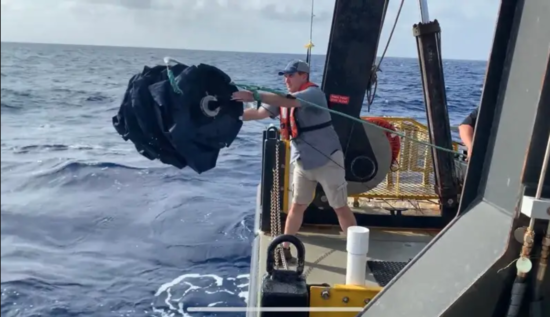
Shown is Poslon, who is also the director of Delaware INBRE’s Bioinformatics Core, releasing the holey sock drogue, a type of sea anchor, that will drift 15 meters below the ocean surface. The science team followed the drogue for two experiments on either side of the Gulf Stream.
In an attempt to study microbes in their natural environment, co-chief scientists Drs. Eric Wommack and Shawn Polson led other members of the Viral Ecology and Informatics Lab (VEIL) in an NSF EPSCoR-funded mission on the R/V Hugh R. Sharp, University of Delaware’s 146-foot ocean-going research vessel. They spent eight days at sea to conduct what is known as a Lagrangian Experiment, monitoring a single water mass over time.
The members of the VEIL involved in the experiment included Wommack; Polson; Barbra Ferrell, VEIL lab coordinator; Rachel Keown, doctoral student in biological sciences; Amanda Zahorik, doctoral student in biological sciences; and Amelia Harrison, VEIL technician and master’s degree graduate in marine biosciences. In addition, they were joined by Bruce Kingham, director of the UD Sequencing and Genotyping Center.
If a person wanted to study gazelles in Africa, the last thing they would want to do is put a fence around them. For one thing, they wouldn’t be able to observe their natural behavior and, for another, the lions would have a field day. The same can be said for microbes in the ocean. Usually, when researchers study ocean microbes, they collect water samples in containers and bring the samples back to the lab. Just like fenced-in gazelles, this doesn’t allow them the chance to observe the microbes’ behavior in their natural habitat.