
National Science Foundation
PROGRAM DESCRIPTION
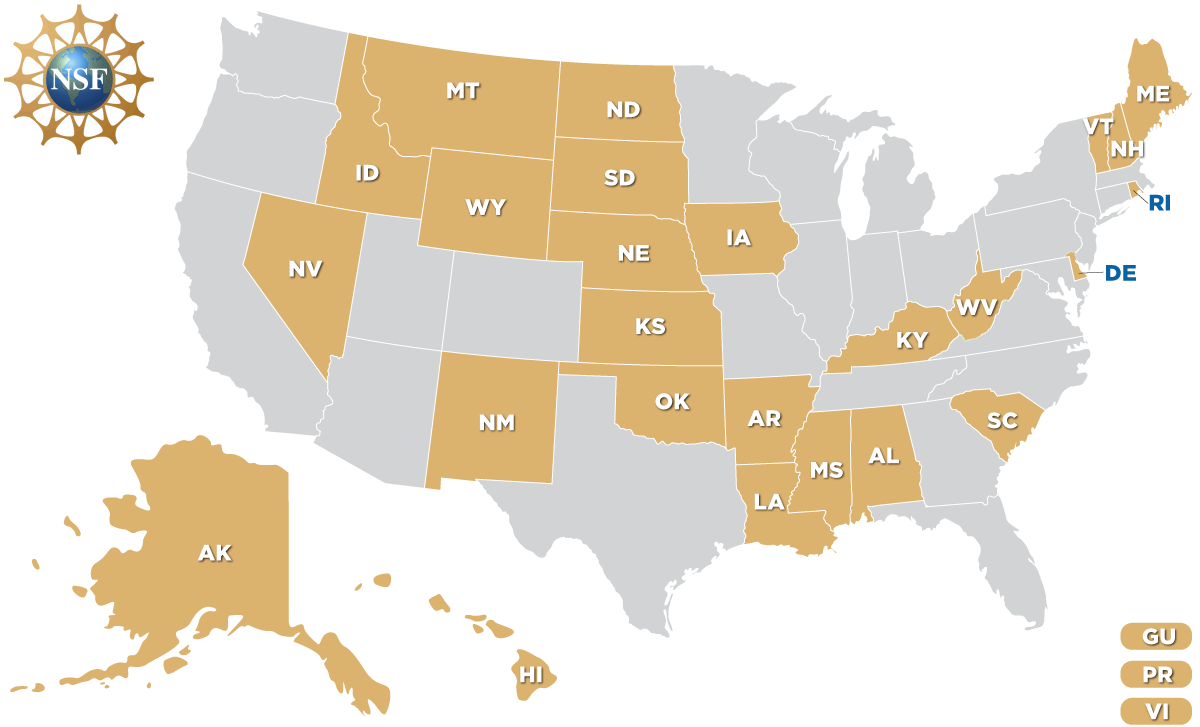
The National Science Foundation's (NSF) Established (formerly Experimental) Program to Stimulate Competitive Research (EPSCoR), which was created in 1979, identifies, develops, and makes the best use of a state’s academic science and technology resources.
Its primary goals are:
- Provide strategic programs and opportunities for EPSCoR participants that stimulate sustainable improvements in their R&D capacity and competitiveness; and
- Advance science and engineering capabilities in EPSCoR jurisdictions for discovery, innovation and overall knowledge-based prosperity
By improving research infrastructure and increasing the capability of scientists to compete for mainstream programs, NSF EPSCoR is building a high-quality, university-based research and education infrastructure capable of supporting a strong and stable economic base into the 21st century.
NSF EPSCoR works through a State Committee in each of its eligible jurisdictions.
INVESTMENT STRATEGIES- Research Infrastructure Improvement (RII) Awards
- Provide up to $4 million per year for up to five years annually to support academic research infrastructure improvements in R&D areas critical to the state’s long-term S&T competitiveness and economic development. research infrastructure development and in maintaining their competitiveness
- Provide up to $2 million dollars per year for up to three years to support research utilizing cyberinfrastructure. Track-2 awards are multi-jurisdictional and seek to develop regional strengths.
- Provide up to $750,000 for up to five years and focus on increasing the participation in STEM fields of underrepresented minorities in underserved rural areas of the United States.
- Five types:
- RII Track-1 awards provide up to $4 million per year for up to five years. They focus on improving the research competitiveness of jurisdictions by improving their academic research infrastructure in areas of science and engineering that are supported by the U.S. National Science Foundation and are critical to a particular jurisdiction's science and technology initiative or plan. These areas must be identified by the jurisdiction's EPSCoR governing committee as having the best potential to improve the jurisdiction’s future R&D competitiveness.
- RII Track-2 Focused EPSCoR Collaborations (FEC) provides two types of collaborative awards:
- Up to $1 million per year for up to four years for collaborations between two EPSCoR jurisdictions
- Up to $1.5 million per year for up to four years to a consortium of three or more EPSCoR jurisdictions.
- RII Track-4: EPSCoR Research Fellows provides awards to build research capacity in institutions and transform the career trajectories of investigators and further develop their individual research potential through collaborations with investigators from the nation's premier private, governmental, or academic research centers. The fellowship provides opportunities to establish strong collaborations through extended or periodic collaborative visits to a selected host site. There are two sub-tracks:
- RII Track-4: NSF - provides up to $300k
- RII Track-4: @NASA - provides up to $360k
- The E-CORE RII program supports jurisdictions in building capacity in one or more targeted research infrastructure cores that underlie the jurisdiction's research ecosystem. Based on the evidence-based and self-identified need of the jurisdiction, capacity building supported by E-CORE RII may include (but is not limited to) development, enhancement, and/or sustainability of: jurisdiction-wide research administration; research facilities; higher education pathways; STEM education (K-16) pathways; broadening participation; workforce development; national and global partnerships; community engagement and outreach; economic development and use-inspired research; and/or early career research trainee pathways. E-CORE RII projects must be designed to support the sustainability of the infrastructure core(s) beyond the award period. In E-CORE RII’s support of one or more research infrastructure cores in an EPSCoR-eligible jurisdiction, the program will also support the development and growth of new jurisdictional networks, and the leveraging of existing jurisdictional networks, that can drive demonstrable and sustainable impact to advance the jurisdiction-wide research ecosystem.
Through the fostering of STEM research ecosystems and research capacity pathways across institution types and sectors in a jurisdiction, E-CORE RII aims to support jurisdiction-wide research infrastructure cores based on jurisdictional variability. A jurisdiction’s science, technology, engineering, and mathematics (STEM) research ecosystem encompasses all new and ongoing interactions among its research environment, researchers, stakeholders, and STEM research activities to improve knowledge, or contribute to end-use or societal impacts in the jurisdiction. - The E-RISE RII program supports the incubation of research teams and products in a scientific topical area that links to research priorities identified in the submitting jurisdiction’s approved Science and Technology (S&T) Plan. E-RISE RII invites innovative proposals that will lead to development and implementation of sustainable broad networks of individuals, institutions, and organizations that will transform the science, technology, engineering and mathematics (STEM) research capacity and competitiveness in a jurisdiction within the chosen field of research. E-RISE RII projects must be designed to incubate (i) areas of research capacity building within a chosen research topic; (ii) development of a skilled workforce that is relevant to the project and its outcomes; (iii) promotion of diversity, equity, access, and a culture of inclusion of different types of academic institutions (see below) and non-academic sectors (e.g., industry and government); (iv) integration of the research with societal impacts in a timebound manner; and (v) sustainability of a clear pathway towards preserving the resulting research incubator's team and products beyond E-RISE RII funding.
- RII Track-1 awards provide up to $4 million per year for up to five years. They focus on improving the research competitiveness of jurisdictions by improving their academic research infrastructure in areas of science and engineering that are supported by the U.S. National Science Foundation and are critical to a particular jurisdiction's science and technology initiative or plan. These areas must be identified by the jurisdiction's EPSCoR governing committee as having the best potential to improve the jurisdiction’s future R&D competitiveness.
- Co-funding of disciplinary and multidisciplinary research: EPSCoR often co-funds proposals submitted to other NSF programs if the applicant is located in an EPSCoR jurisdiction. The proposals selected for this funding have been merit reviewed and recommended for award, but could not be funded without the combined support of EPSCoR and the co-funding directorates. Co-funding leverages EPSCoR investment and facilitates participation of EPSCoR scientists and engineers in NSF-wide programs and initiatives.
- Workshops and outreach: EPSCoR funds workshops, conferences and other community-based activities to explore opportunities in emerging areas of science and engineering, and to share best practices in strategic planning, diversity, communication, cyberinfrastructure, evaluation and other areas of importance to EPSCoR jurisdictions (See NSF 19-588).
- Acronym
- NSF EPSCoR
- Cognizant Office
- Office of Integrative Activities
- Program Officer
-
Sandra Richardson
Section Head
National Science Foundation
2415 Eisenhower Avenue
Office of Integrative Activities, Room W 17109
Alexandria, VA 22314
U.S.Phone: (703) 292-4657